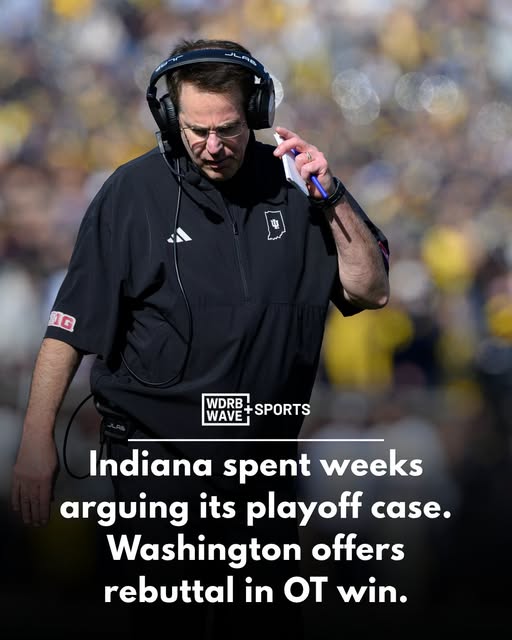
There was a time this season when the Hoosiers scored touchdowns as casually as other teams exchange punts.
That team has been missing for a while.
Through its first five games, Indiana averaged 44 points. Over its next four, that average dropped below 18. The Hoosiers won three of those four, the exception a 19-15 loss to Ohio State, and winning is the best way to keep people from examining the plumbing.
But the pipes were rattling.
Against Minnesota, backup quarterback Grant Wilson rescued Indiana in overtime. Against USC, Wilson delivered again, and the Hoosiers escaped with a victory that looked more comfortable on the scoreboard than it felt during the game.
Saturday, there was no escape. And no shortage of warning signs.
Washington quarterback Demond Williams Jr. announced the Huskies’ intentions with a 65-yard touchdown run on their opening possession. Indiana answered immediately when Wilson connected with Charlie Becker for a 74-yard touchdown.
For a few minutes, it looked like somebody had found the Indiana offense that had gone missing in October. Wilson added a 5-yard touchdown run, and the Hoosiers led 14-7.
They would not score another touchdown until the fourth quarter.
That’s a long time to ask a defense to keep making up the difference, particularly against an opponent that was moving the ball as effectively as Washington.
The Huskies rolled up 189 rushing yards. Williams accounted for 127 of them himself, repeatedly presenting Indiana with the kind of problems that don’t disappear because somebody makes an adjustment on the sideline.
Cignetti had specifically called out his defense’s problems against mobile quarterbacks during the week. Then Williams went out and demonstrated exactly what the coach had been talking about.
Washington gained 264 yards in the first half alone, averaging more than seven yards per play and producing nine explosive plays. Preston Zachman’s interception in the end zone kept the damage from being worse.
Indiana’s defense eventually settled down. But Washington had already established that it could move the football, and when the game was on the line, the Huskies remembered how.
Indiana, meanwhile, spent much of the afternoon searching for an offense.
Wilson, who had been so effective in relief of the injured Josh Hoover, completed 8 of 16 passes for 119 yards and a touchdown. But the offense stalled badly enough that Cignetti turned back to Hoover in the third quarter.
Cignetti said he entered the game fully expecting Wilson to play throughout. But he sensed the offense getting shaky and decided to make the switch.
Hoover provided a spark. He completed 7 of 13 passes for 121 yards, including a 35-yard touchdown to Nick Marsh that put Indiana ahead 24-17 with 9:06 remaining.
The quarterback change worked. It just didn’t fix everything else.
For a moment, it looked like another Cignetti escape act. Indiana’s defense had recovered from its disastrous first half. Hoover had restored some life to the offense. The Hoosiers had a seven-point lead in the fourth quarter.
All they had to do was finish.
Washington had other ideas.
The Huskies marched 74 yards in seven plays, using a trick-play pass from receiver Dezmen Roebuck to Chris Lawson for 27 yards to help set up Williams’ 20-yard touchdown pass to tight end Decker DeGraaf with 3:34 remaining.
Tie game. Indiana had time to answer. It couldn’t.
And when overtime arrived, Washington needed only a field goal to put the pressure squarely back on a Hoosiers offense that had spent much of the afternoon struggling under it.
Indiana’s possession went nowhere. McAteer’s kick was deflected.
Game over.
The questions, however, are just getting started.
Indiana is 9-2. That is hardly a disaster. For most of the program’s history, nine victories would have been cause for a parade, a commemorative plaque and possibly a municipal holiday.
But Cignetti has changed the standards in Bloomington. That’s the price of winning a national championship. Nobody judges you by the standards of the Indiana teams that came before you. They judge you by the standard you established yourself.
And by that measure, Saturday was a real disappointment.
There are explanations. Indiana has been dealing with injuries at quarterback, running back and along the offensive line.
Starting right guard Joe Brunner suffered a non-contact ACL injury in practice before the USC game. Then, on Saturday, starting center Bray Lynch was rolled up from behind on a fourth-down running play and had to leave the game.
Austin Leibfried, who had stepped in for Brunner, moved to center. Baylor Wilkin took over at right guard. Right tackle Adedamola Ajani also played through an injury.
That’s a lot of moving parts for an offense already struggling to find its rhythm.
Those absences matter. They help explain why a team that once seemed capable of scoring at will now struggles to sustain drives. But explanations don’t move the chains. Two conversions in 15 third-down attempts will lose a lot of football games, regardless of who’s playing quarterback.
The Hoosiers finished with 392 yards, a total that looks respectable until you consider that two touchdown passes accounted for 109 of their 240 passing yards.
Indiana’s offense could still produce the spectacular. What it couldn’t produce consistently was the ordinary.
A first down when it needed one. A drive that gave the defense a rest. Three or four consecutive productive plays without something going wrong.
Cignetti described the offensive struggle as “fighting an uphill battle a little bit, trying to scratch out a few yards.”
That’s a revealing description of an offense that was averaging 44 points a game earlier this season.
Championship football is built on those ordinary things. And now the playoff math has become less friendly.
Cignetti has been particularly vocal about the way Indiana has been evaluated, questioning why the Hoosiers dropped five places in the playoff rankings during a bye week and received only a modest bump after beating USC.
He had a point. Rankings are supposed to reward results, and Indiana had been producing them.
But the committee already had the Hoosiers behind multiple two-loss SEC teams. Now Indiana has joined the two-loss crowd, and several teams chasing the Hoosiers have done themselves favors.
BYU, Wake Forest and Texas Tech all won Saturday. Oregon won Friday. Other contenders aren’t standing around waiting for Indiana to recover.
The Hoosiers could beat Purdue next week, finish 10-2 and still find themselves on the wrong side of the playoff bracket.
Their path to the Big Ten championship game has become more difficult, too.
Before Saturday, Indiana could guarantee itself a place in Indianapolis simply by winning its final two games. Now the Hoosiers can finish no better than 7-2 in conference play, and the championship race has become a tiebreaker problem. And Indiana will need help.
Without a conference championship opportunity, Indiana’s playoff case becomes considerably more precarious.
That’s a difficult position for a program that entered Saturday controlling far more of its own destiny.
For weeks, Cignetti has been arguing that Indiana deserves more credit for what it has accomplished. The Hoosiers have won so much under him that four losses in three seasons qualify as something approaching a crisis.
But the College Football Playoff committee isn’t grading Indiana on the distance traveled from its miserable past. It’s grading the team on the field today.
And that team has some problems. An offense that can’t stay on the field. An offensive line running out of healthy bodies. A quarterback change that worked and still didn’t solve the problem. And, on Saturday, a kicking operation that couldn’t get two important field goals past Washington’s outstretched hands.
Cignetti has spent much of November arguing about where Indiana belongs in the playoff rankings.
After Saturday, he has a more urgent problem.
Making sure the Hoosiers belong in the playoff at all.