Hall of Famer’s Son Reportedly Turns Toward Indiana Hoosiers Workout After Iowa Scholarship Interest, Eyes Path to NFL Greatness
The Indiana Hoosiers continue to attract attention as college football’s recruiting landscape evolves, with player development, coaching relationships and opportunities for long-term growth becoming increasingly important factors in recruiting decisions.
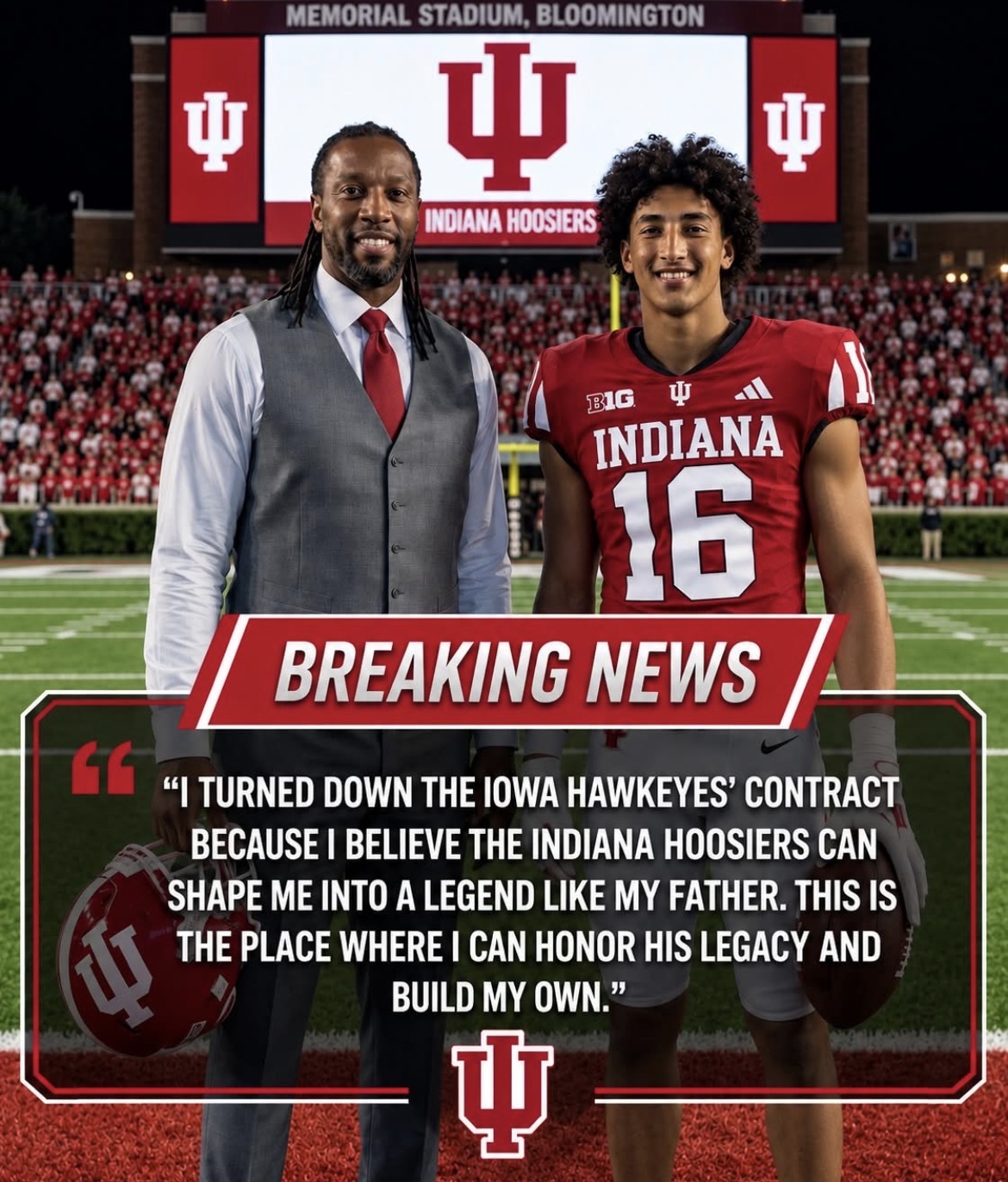
A reported recruiting storyline involving the son of a Pro Football Hall of Famer has raised questions about Indiana’s appeal to prospects hoping to establish their own football identities while following in the footsteps of legendary fathers.
However, the specific claim that a Hall of Famer’s son rejected an Iowa scholarship offer to work out with Indiana could not be independently verified through reliable reporting. The identity of the prospect and the details of the alleged decision therefore remain unconfirmed.
Still, the broader story highlights an important question for Indiana: Can the Hoosiers continue building a program that convinces talented young athletes they can develop in Bloomington and pursue their professional football ambitions?
Indiana’s Growing Appeal to Prospects
Indiana’s emergence as a serious college football contender has changed the conversation surrounding the program.
Under head coach Curt Cignetti, the Hoosiers have demonstrated that they can compete with established national powers. That progress has strengthened the program’s profile and created opportunities to attract players who might previously have overlooked Bloomington.
For recruits, choosing a college involves more than evaluating a school’s history or reputation. Coaching, player development, competition, academic opportunities and the potential path to meaningful playing time can all influence the decision.
Those considerations become particularly important for young athletes who hope to reach the NFL.
A talented prospect must identify a program capable of challenging him, helping him improve his technique and preparing him for increasingly difficult competition. The right environment can help a player develop his strengths while addressing weaknesses that might otherwise limit his progress.
Indiana’s recent rise gives the Hoosiers a compelling opportunity to make that case to recruits.
Nevertheless, a program’s reputation must be supported by a convincing development plan. Prospects and their families need to evaluate the coaching staff, the position group, the available opportunities and the expectations associated with joining the team.
For Indiana, the objective is to turn its growing national profile into sustained recruiting success.
A Hall of Fame Legacy Can Bring Opportunity — and Pressure
Being the son of a Hall of Famer creates an unusual starting point for a young football player.
The family connection can generate attention, provide access to valuable experience and offer an example of what sustained dedication can accomplish. At the same time, it can create expectations before the younger athlete has established a meaningful résumé of his own.
Every performance can invite comparisons. Every recruiting development can become a larger story because of the family name.
But football success is never guaranteed by lineage.
A famous father cannot take the younger player’s snaps, make decisions on the field or replace the work required to improve. The next generation must establish its own identity through preparation, consistency and performance.
That is why a player’s college decision can be significant beyond the immediate recruiting headlines.
The right program can provide an environment where a young athlete focuses on developing his abilities instead of allowing outside expectations to define his career.
For a prospect with NFL ambitions, the ultimate goal is not simply to inherit a legacy. It is to build a career that can stand on its own merits.
Why a Workout Could Matter
A college workout can be an important part of the recruiting process, giving coaches an opportunity to evaluate an athlete’s physical abilities, technique, movement and response to instruction.
It can also help a prospect determine whether a program’s expectations and coaching approach align with his goals.
However, a workout is not the same as receiving a scholarship offer, accepting an offer or committing to a school. Each represents a different stage of the recruiting process.
That distinction matters when evaluating reports about Indiana’s involvement with a Hall of Famer’s son.
Without a confirmed statement from the player, his representatives or the schools involved, it would be premature to conclude that Indiana has secured a recruiting victory over Iowa.
What can be said is that the opportunity to evaluate a prospect can help both sides determine whether a relationship deserves to develop further.
If the Hoosiers are involved in such a workout, the next step would be demonstrating how their coaching staff could help the athlete improve and compete at the college level.
The NFL Dream Starts With Development
For young players who aspire to reach the NFL, talent is only one part of the equation.
Consistent training, technical improvement, football intelligence, physical preparation and the ability to respond to coaching all contribute to long-term development.
College football provides an important proving ground because players face stronger opponents, more sophisticated schemes and greater demands on their preparation.
A successful transition requires athletes to adapt quickly and demonstrate that their abilities translate against high-level competition.
Indiana’s recruiting pitch can therefore extend beyond the possibility of playing in major games. The Hoosiers can emphasize the importance of preparation, competition and finding a role that allows each athlete to contribute.
Still, no college program can guarantee that a recruit will become an NFL star.
Even highly regarded prospects face uncertainty as they progress through high school, college and the professional evaluation process. Development takes time, and outcomes depend on performance, opportunity, health and numerous other factors.
For a Hall of Famer’s son, the challenge is to turn inherited knowledge and individual potential into accomplishments of his own.
What the Story Could Mean for the Hoosiers
If Indiana is pursuing a talented prospect with a famous football background, the recruitment would provide another opportunity for the program to demonstrate its growing appeal.
The Hoosiers would need to show why their coaching, culture and development opportunities make Bloomington a strong fit.
That message could resonate with recruits who prioritize a clear path to improvement over the prestige associated with a traditional powerhouse.
It would also reinforce an important principle in modern college football recruiting: players have to consider how a program fits their individual needs rather than making decisions based on reputation alone.
For Indiana, building relationships with talented prospects is only the beginning. The larger challenge is converting recruiting interest into a roster capable of competing consistently at the highest level.
That requires effective evaluation, player development and a clear understanding of what each recruit can contribute.
The same standards apply to any prospect carrying a famous family name.
The Final Word
The reported story of a Hall of Famer’s son choosing an Indiana workout over an Iowa scholarship opportunity would make for an intriguing recruiting headline. However, the specific decision remains unverified, and the prospect’s identity has not been reliably established.
What remains clear is that Indiana’s rise has made the program an increasingly interesting subject in discussions about recruiting, development and the pursuit of professional football careers.
For a young athlete hoping to follow his father’s path to greatness, the challenge is ultimately the same as it is for every other prospect: improve, compete and prove his ability on the field.
A Hall of Fame legacy can inspire the next generation, but it cannot determine what comes next.
If Indiana eventually becomes the right destination for such a player, the real story will not simply be that a famous football family is connected to the Hoosiers.
It will be whether the player can use that opportunity to build a legacy of his own.