HEARTWARMING: Ryan Day’s Impact Off the Field Draws Attention as Ohio State Coach Continues His Commitment to Helping Children
COLUMBUS, Ohio — Ryan Day has spent much of his coaching career being judged by scoreboards, championship trophies and the increasingly unforgiving standards attached to Ohio State football. But one of the most meaningful measures of his leadership has little to do with what happens between the lines.
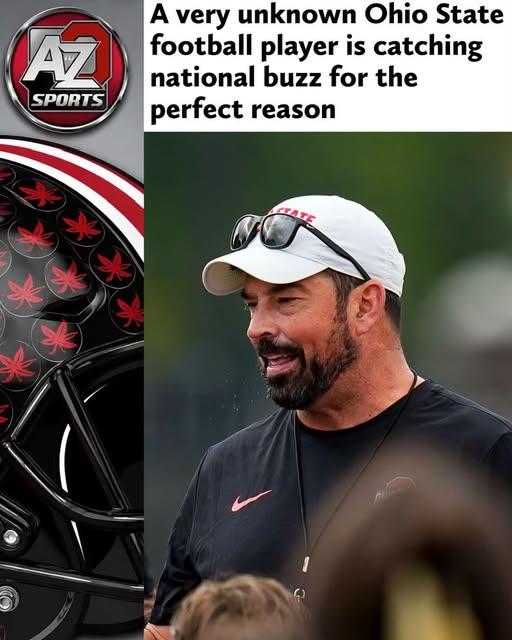
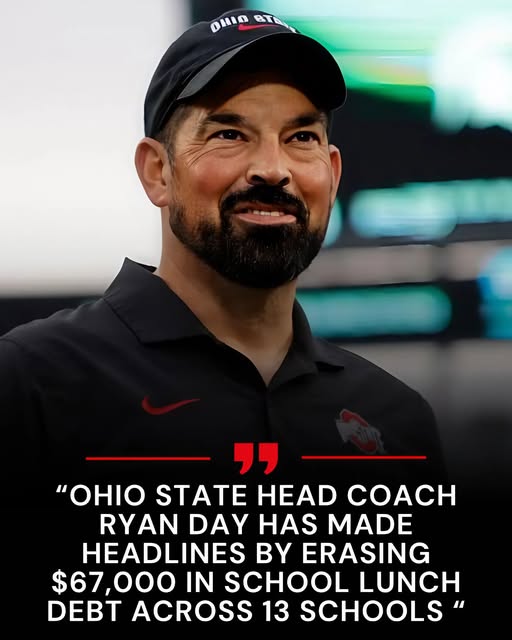
A report circulating around college football claims that Day helped eliminate roughly $67,000 in school lunch debt across 13 schools, an act of generosity that would have provided immediate relief for families and students facing food insecurity. The specific donation has not been independently confirmed by Ohio State or another authoritative source, and the widely circulated quote attributed to Day — that the gesture represented “a victory greater than any championship” — also could not be verified.
What is not in question, however, is Day’s established record of charitable work, particularly involving children, mental health and food insecurity.
That record provides important context for why a story centered on helping students has resonated so strongly with Ohio State fans.
Day and his wife, Nina, have repeatedly used their platform and personal resources to support causes involving young people. In 2020, during the COVID-19 pandemic, the Days joined Ohio State athletic director Gene Smith and his wife, Sheila, and then-Buckeyes basketball coach Chris Holtmann and his wife, Lori, in committing a combined $175,000 to the Mid-Ohio Foodbank’s emergency fund. The effort was designed to help families dealing with increased food insecurity during the pandemic.
That commitment to community service has continued well beyond the pandemic.
The Days made a $1 million gift to Ohio State in 2022 to establish the Nina and Ryan Day Resilience Fund, supporting research and services focused on mental health and resilience. Ohio State has described the initiative as part of the couple’s broader effort to encourage young people and adults to discuss mental health openly and seek help when needed.
In 2024, the Days were recognized with the STAR Award for Outstanding Contributions in the Fields of Trauma and Resilience for their advocacy and philanthropic work. Their efforts have also supported programs intended to provide mental-health resources for student-athletes and eventually create models that can be replicated at other universities.
And in July, Day was named one of the nominees for the 2026 Allstate AFCA Good Works Team, an honor recognizing college football coaches and players for significant commitments to community service. Ohio State specifically highlighted the Days’ resilience fund and their work providing mental-health educational resources to classrooms.
That history makes the reported lunch-debt story consistent with the type of philanthropy Day has pursued throughout his time in Columbus, even though the specific $67,000 figure remains unverified.
The significance of school meal debt goes beyond a balance sheet.
For families living close to the financial margin, unpaid meal charges can become another source of stress. School meals are not simply an administrative expense. For many children, they represent an important part of the nutrition they receive during the day. Eliminating outstanding balances can therefore provide immediate assistance while removing a burden from parents and guardians.
For a football coach whose professional life revolves around preparation, discipline and performance, the symbolism is striking.
Day’s job requires him to spend enormous amounts of time thinking about third-down efficiency, explosive plays, pass protection, defensive structure and roster construction. His program operates in an environment where recruiting battles can involve millions of dollars in name, image and likeness resources and where every loss can generate questions about leadership.
Yet the most important contribution on a given day may have nothing to do with recruiting rankings or playoff positioning.
That distinction is particularly relevant at Ohio State, where expectations are among the highest in American sports.
Day has built one of the nation’s most successful programs since becoming the Buckeyes’ full-time head coach. As of June 15, 2026, he had an 82-12 record at Ohio State, including a 55-5 mark against Big Ten opponents. His .872 winning percentage at the school ranks first nationally among Division I head coaches and second all time, according to Ohio State.
His résumé also includes two Big Ten championships and five College Football Playoff appearances.
The defining achievement came during the 2024 season.
Ohio State finished 14-2 and became the first team to win four playoff games in a single College Football Playoff, defeating Tennessee, Oregon, Texas and Notre Dame on the way to the national championship. The Buckeyes defeated Notre Dame 34-23 in Atlanta on Jan. 20, 2025, claiming the program’s first national title since 2014.
That championship transformed the conversation surrounding Day.
For years, the coach had been evaluated through the narrowest possible football lens. Four consecutive losses to Michigan had placed his job security under intense scrutiny entering the 2024 postseason. The Buckeyes responded by winning the games that mattered most, producing one of the strongest postseason runs in the sport’s modern history.
Ohio State subsequently rewarded Day with a seven-year contract extension through the 2031 season.
The agreement carries $12.5 million in annual compensation, with a $2 million base salary, and includes significant buyout and bonus provisions. According to contract details reported by CBS Sports, the school buyout was set at $11.5 million for each remaining year, while Day’s own buyout was $6 million initially before declining under the agreement. The contract also includes potential bonuses totaling as much as $1.55 million and a $250,000 retention bonus in 2027.
College football does not have an NFL-style salary cap, so the financial implications of Day’s contract are different from those attached to an NFL head coach’s deal. Ohio State’s expenses instead exist within the broader economics of a modern college football program increasingly shaped by revenue sharing, NIL, roster management, transfer-portal spending and the cost of maintaining championship-level infrastructure.
That makes Day’s charitable work an interesting counterpoint to the increasingly commercial nature of the sport.
The coach is operating at the center of a business where elite programs spend enormous sums attempting to gain competitive advantages. Ohio State’s football operation is expected to compete for national championships every season. Its recruiting department evaluates teenagers years before they arrive on campus. Its personnel staff constantly monitors the transfer portal. Its coaching staff analyzes every snap.
But none of that changes the basic responsibility of helping young people.
That may ultimately be the most important part of the story surrounding the reported lunch-debt donation.
If the $67,000 figure is eventually confirmed, it would represent another tangible example of Day directing his influence toward children and families who have little connection to the outcome of an Ohio State game. If it is not confirmed, his documented philanthropic record still demonstrates that community service has become a meaningful part of his public leadership.
Ohio State itself has emphasized the importance of addressing food insecurity. The university’s student philanthropy programs identify food access as one of the areas where donors can help students and community members facing financial pressure.
That broader mission matters because hunger and education are inseparable issues. A student struggling to concentrate because of food insecurity is fighting a battle that has nothing to do with intelligence, effort or potential.
Football coaches understand the concept of removing distractions.
A quarterback cannot execute an offense effectively while constantly worrying about pressure coming from his blind side. A linebacker cannot diagnose a read-option play if he is distracted before the snap. In much the same way, a child has a harder time focusing on mathematics, reading or science when basic needs are uncertain.
That is where philanthropy can make a difference.
Day’s legacy at Ohio State will inevitably be measured by wins and losses. His 2024 national championship will remain the centerpiece. His success against Big Ten opponents will remain part of the record book. His ability to recruit and develop NFL-caliber talent will continue to shape how the program is judged.
But leadership is rarely confined to statistics.
The most revealing measure may be what a person chooses to do when there is no scoreboard, no trophy and no television audience.
For Day, that has increasingly meant using the platform that comes with coaching Ohio State to support causes affecting children and families.
Whether the reported $67,000 lunch-debt story ultimately receives independent confirmation or not, the larger lesson remains clear: the influence of a major college football coach extends well beyond the stadium.
In Columbus, Day has already built a résumé that includes championships, playoff victories and historic regular-season success.
His philanthropic record suggests he wants the definition of winning to be broader than that.
And sometimes, the most meaningful victory is the one that never appears in the standings.