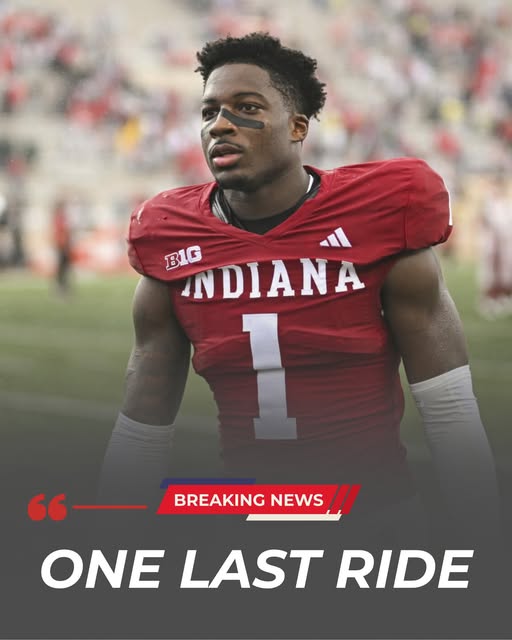
HE’S BACK FOR ONE LAST RIDE: Former Indiana Hoosiers Star Has Reportedly Agreed to Return to Bloomington for One Final College Football Season — And the NCAA World Is Buzzing
Bloomington, Indiana — What looked like the beginning of the end has instead become one of the most unusual eligibility sagas in modern college football.
Stephen Daley, one of the most productive pieces of Indiana’s historic 2025 defense, elected to return to Bloomington for a fifth college football season after a federal court ruling temporarily opened the door for members of the 2022 recruiting class to receive another year of eligibility. The move immediately gave defending national champion Indiana another veteran pass rusher and injected new intrigue into a program preparing to defend its title.
But there is an important caveat: Daley’s return is not currently guaranteed to translate into game action.
The legal foundation that initially cleared him to play has since been stayed by the U.S. Court of Appeals for the 10th Circuit. As of late August, Daley remains with the Hoosiers and is practicing, but he is not presently eligible to play in games. Indiana coach Curt Cignetti has continued to support Daley and fellow defensive lineman Kellan Wyatt as their eligibility situations play out.
That distinction has become central to a story that goes well beyond one defensive lineman.
Daley’s decision came Aug. 4, shortly after a Colorado federal judge issued a preliminary injunction allowing athletes from the 2022 high school class an additional season. ESPN’s Pete Thamel first reported Daley’s intention to return to Indiana. The former Kent State standout had transferred to Bloomington ahead of the 2025 season and immediately became an important component of Cignetti’s defense.
The timing could hardly have been more significant.
Indiana had just completed the greatest season in program history, finishing 16-0 and winning the national championship. The Hoosiers defeated Alabama 38-3 in the Rose Bowl, Oregon 56-22 in the Peach Bowl and Miami 27-21 in the College Football Playoff championship game. Indiana’s defense allowed only 11.7 points per game and 266 total yards per game, while the offense averaged 41.6 points.
Daley was a major reason the defensive identity was so difficult to attack.
He led Indiana with 19 tackles for loss during the championship season and recorded 5.5 sacks. His season ended in frustrating fashion, however, when he suffered a knee injury during the celebration following Indiana’s 13-10 victory over Ohio State in the Big Ten championship game. The injury prevented him from participating in the College Football Playoff.
For a player who had already experienced the abrupt ending of one season, the opportunity to return represented something considerably more meaningful than simply adding another year to a résumé.
It was unfinished business.
Daley’s development also illustrates the unconventional roster-building model that has fueled Indiana’s transformation under Cignetti. Before arriving in Bloomington, he spent three seasons at Kent State, where he accumulated 103 tackles, 15.5 tackles for loss and six sacks. His emergence at Indiana was another example of Cignetti identifying experienced players who could become high-impact contributors in the Big Ten.
The Hoosiers now find themselves trying to manage that experience against a rapidly changing eligibility landscape.
The NCAA’s so-called “five-for-five” eligibility model was designed to give Division I athletes five seasons of eligibility within a five-year period, but the rollout has collided with a series of lawsuits involving athletes from the 2022 recruiting class. A Colorado ruling temporarily expanded the opportunity to players such as Daley and Wyatt. The NCAA appealed, and the 10th Circuit subsequently stayed the injunction, leaving both Indiana defenders in an eligibility limbo.
Cignetti has acknowledged the unusual circumstances without pretending the outcome is within his control.
“We’re taking that day by day,” Cignetti said, according to WFIU, while expressing his desire for Daley and Wyatt to regain eligibility.
That uncertainty is particularly consequential for Indiana because the defensive line was already expected to be one of the team’s strongest units.
The Hoosiers lost significant production from their championship roster, but they attacked the position aggressively in the transfer portal, adding Tobi Osunsanmi from Kansas State, Chiddi Obiazor and Josh Burnham from Notre Dame. Indiana also returns interior standout Tyrique Tucker and Mario Landino. The potential availability of Daley and Wyatt would give Cignetti an unusually deep collection of experienced pass rushers.
Wyatt’s situation mirrors Daley’s.
After transferring from Maryland, Wyatt played seven games for Indiana in 2025 before a knee injury ended his season. He finished that abbreviated campaign with 27 tackles, 8.5 tackles for loss and 2.5 sacks. Across his four college seasons, Wyatt has produced 107 tackles, 23 tackles for loss and 11 sacks.
The potential return of both players therefore changes the mathematical profile of Indiana’s defense.
More experienced edge defenders mean more flexibility in third-down packages, greater ability to rotate defensive linemen without sacrificing pass-rush efficiency and more freedom for Cignetti’s staff to create pressure without relying exclusively on blitz volume.
But the larger question is whether either player will actually be available when the games begin.
Indiana opens its 2026 season Sept. 5 against North Texas, a team that finished 12-2 last season and averaged 512.4 yards and 45.1 points per game. That makes the eligibility uncertainty especially uncomfortable: Indiana is preparing to face an explosive offense while simultaneously planning its defensive personnel without knowing whether two experienced defenders can participate.
And there is no NFL salary-cap complication attached to Daley’s return because he has not signed an NFL contract. The more relevant financial issue is the evolving NIL economy, where returning veteran players can command meaningful compensation and roster resources. Indiana’s broader 2026 roster reflects that reality: the program entered the season with 60 returning players and 44 newcomers, including 18 transfers.
That roster construction is part of why Indiana remains nationally relevant even after losing Heisman Trophy-winning quarterback Fernando Mendoza and several other championship contributors.
Cignetti is not rebuilding. He is reloading.
Indiana enters 2026 ranked No. 6 in the preseason AP poll, according to the school’s historical records, after becoming the first team in program history to finish a season undefeated with a national championship.
The stakes, consequently, extend beyond Bloomington.
If Daley ultimately receives clearance, Indiana could regain one of its most disruptive defenders while simultaneously adding another layer of experience to a defense that already ranked among the nation’s best. If the NCAA’s position prevails, the Hoosiers will have to move forward without him despite having invested months of preparation into his return.
That is the strange reality of college football in 2026.
Eligibility lawsuits, conference rules, transfer-portal movement and NIL economics have made roster management increasingly similar to professional front-office work, except the rules can change while the season is already approaching.
The Big Ten has also moved aggressively against athletes with previous professional experience, adopting a rule this month barring certain former NFL players from returning to college competition. That policy is part of a broader conference response to the legal turmoil surrounding eligibility. Daley’s case is different because he was not drafted or signed by an NFL team, but his situation remains caught in the same national debate over who should be permitted to extend a college career.
For Indiana, the simplest version of the story remains the most compelling.
Daley wanted another season.
He chose Bloomington.
He is practicing with the defending national champions.
And for now, he is waiting.
Whether that final ride eventually becomes a reality on Saturdays will depend not on Cignetti’s depth chart, Daley’s production or Indiana’s ambitions, but on a legal battle that has turned the final days before kickoff into another chapter in college football’s rapidly changing eligibility era.
For a program that spent years trying to reach the summit, the challenge now is learning how to operate at the top while the ground beneath the sport continues to move.