Indiana is getting closer to seeing two of the most disruptive pieces of its championship-caliber defensive front back at full strength, but coach Curt Cignetti is making it clear that Stephen Daley and Kellan Wyatt will not be rushed.
Cignetti recently provided an update on the two veteran defensive linemen as the Hoosiers work through fall camp, saying Daley is nearing a return to full-contact, 11-on-11 work while Wyatt is progressing on a more gradual timetable. Both players are returning to Indiana after injuries ended their 2025 seasons, giving the defending national champions another potential boost along a defensive line that already has significant depth.
The update carries considerable weight because Indiana’s defense was one of the defining strengths of its historic 2025 campaign. The Hoosiers went 16-0 and won the program’s first national championship, following a 13-10 victory over Ohio State in the Big Ten Championship Game and a subsequent College Football Playoff run that established Cignetti’s program as a national power.
Daley and Wyatt were important contributors before injuries interrupted their seasons.
Wyatt, who transferred to Indiana from Maryland, established himself quickly as a disruptive presence. Through Indiana’s first seven games in 2025, he had 27 tackles, eight tackles for loss and 2.5 sacks before suffering a knee injury against Michigan State on Oct. 18. Cignetti initially described the injury as long term, and Wyatt ultimately missed the remainder of the season.
Daley then assumed a larger role.
The former Kent State defensive lineman had already shown flashes of being one of Indiana’s best pass-rushing weapons, but Wyatt’s absence accelerated his responsibilities. Over the final six games of the regular season and the Big Ten Championship Game, Daley recorded 13.5 tackles for loss, four sacks and 25 total tackles. He finished the regular season and championship game with 38 tackles, 19 tackles for loss, 5.5 sacks and two forced fumbles, leading the Big Ten in tackles for loss.
That production made Daley’s eventual injury particularly damaging.
Daley suffered a knee injury during the celebration following Indiana’s victory over Ohio State in the Big Ten Championship Game. He was subsequently ruled out for the remainder of the Hoosiers’ postseason, leaving defensive coordinator Bryant Haines without two key edge players during Indiana’s run to the national championship. Haines acknowledged before the Peach Bowl that both Daley and Wyatt were significant losses.
“Those are two key pieces of the defense,” Haines said, according to Indiana’s athletics department.
Indiana managed to compensate.
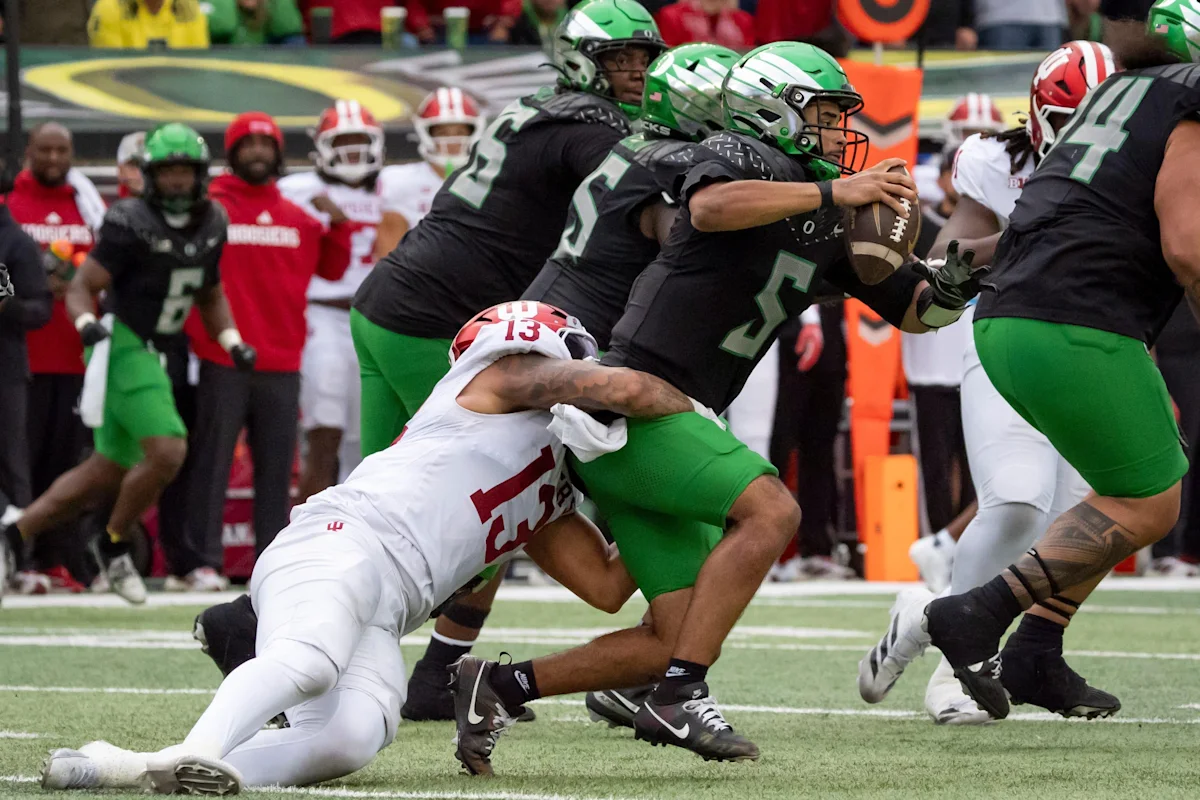
Daniel Ndukwe emerged as one of the defense’s biggest postseason surprises, recording two sacks, forcing a fumble and blocking a punt in the Peach Bowl against Oregon. The Hoosiers also continued to lean on a deep collection of defensive linemen as Haines maintained an aggressive front that consistently created negative plays without requiring excessive blitz volume.
That depth could become even more dangerous if Daley and Wyatt return healthy.
Cignetti’s latest comments suggest the coaching staff is taking a conservative approach. Daley is closer to full participation, while Wyatt is still working through his rehabilitation. The distinction matters because the objective in August is not simply to get veteran players onto the practice field; it is to have them healthy enough to withstand the physical demands of a full season.
For Indiana, that is particularly important given what happened last year.
The Hoosiers’ defensive front helped set the tone against some of the nation’s best offenses. Indiana held opponents to 11.7 points per game during the 2025 season, and the unit played a major role in the program’s undefeated championship run. The defensive line’s ability to generate pressure and stop the run allowed Indiana to play fast on the back end while keeping opposing quarterbacks uncomfortable.
The challenge now is replacing the production lost elsewhere while determining how much Daley and Wyatt can contribute.
Indiana has already prepared for significant turnover. Tyrique Tucker returns after producing 40 tackles, 12 tackles for loss and six sacks in 2025. Mario Landino also returns after recording 32 tackles, six tackles for loss and five sacks. Daniel Ndukwe is back as well, while Indiana added Kansas State transfers Tobi Osunsanmi and Chiddi Obiazor and Notre Dame transfer Josh Burnham.
That gives Haines considerable flexibility.
Tucker, in particular, has inherited a greater leadership role after playing alongside Daley, Wyatt and former star Mikail Kamara. The fifth-year senior acknowledged that the responsibility has shifted toward him as Indiana attempts to maintain the standard established by last season’s defensive unit.
“We have a lot of young guys,” Tucker said in June. “I want to be an example and set the standard because I know what the standard is.”
The return of Daley and Wyatt would therefore be about more than adding two names to the depth chart. It would give Indiana experienced players who already understand Haines’ defensive system, have played meaningful Big Ten football and have proven capable of producing explosive plays against high-level competition.
It could also change the way Indiana deploys its front.
Daley’s combination of size, speed and suddenness allows him to attack offensive tackles from multiple alignments. During his time at Kent State, he totaled 103 tackles, six sacks and an interception in 34 games. At Indiana, his production jumped dramatically once he became a larger part of the rotation.
Wyatt brings a different element. His versatility allows Indiana to move him between the defensive line and linebacker alignments, creating potential protection problems for offenses attempting to identify where pressure is coming from before the snap. His 2025 production before the injury demonstrated that capability.
For opposing offensive coordinators, the potential combination of Wyatt, Daley, Tucker and Indiana’s younger defensive linemen creates a difficult preparation problem. If the veterans are healthy, Haines can rotate personnel more aggressively, preserve pass-rush effectiveness late in games and use simulated pressures without exposing the defense to the same level of fatigue.
That matters in the Big Ten.
Indiana is no longer approaching the season as a surprise contender. The Hoosiers enter 2026 as the defending national champions, and every opponent will have a target on their back. The Big Ten schedule will offer little room for defensive inconsistency, particularly as programs such as Ohio State, Oregon, Michigan and Penn State continue to build rosters capable of competing for the College Football Playoff.
The conference itself is coming off a remarkable season, with Indiana, Ohio State and Oregon all reaching the 12-team playoff. The Big Ten also owns three consecutive national championships entering 2026, making the league’s weekly competition increasingly unforgiving.
That is why Cignetti’s cautious approach to Daley and Wyatt makes sense.
Indiana does not need either player to prove anything in August. The objective is to have them available when the games begin to carry championship consequences.
The Hoosiers already know what the defense looks like without them. They survived the injuries, developed young contributors and finished the job. But a healthy Daley and Wyatt could give Indiana something it did not have during the second half of its championship run: its preferred veteran defensive front at full strength.
The question now is timing.
Daley appears to be closer to returning to unrestricted work, while Wyatt remains on a slower recovery track. Cignetti’s message has been consistent: patience matters more than August headlines.
For a program trying to defend a national championship, that may be the most important development of all.
Indiana does not need Daley and Wyatt merely back on the field. It needs them back when they are ready to play at the level that made them essential to the Hoosiers’ historic rise.
If both reach that point, Haines will have another weapon at his disposal — and the rest of the Big Ten may have to deal with a defensive front that is deeper, more experienced and potentially more versatile than the one that helped Indiana make history a year ago.