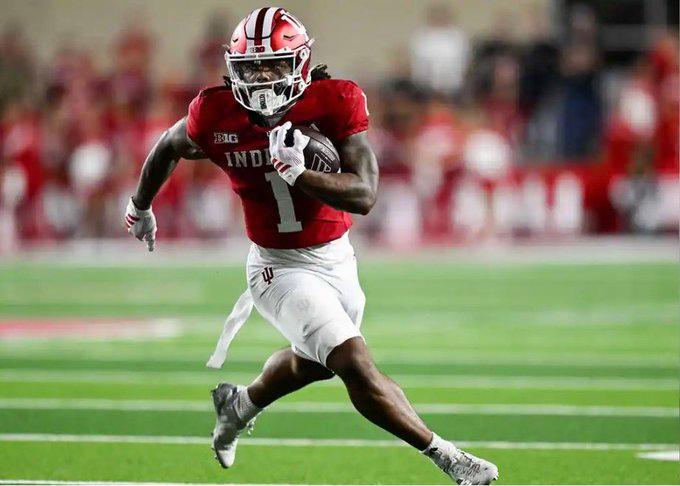
For Nebraska, the margin for error against Indiana may come down to one fundamental question: Can the Cornhuskers find a way to slow down Turbo Richard?
Richard has quickly emerged as one of the most dangerous running backs in the Big Ten, giving Indiana another dimension in an offense that can punish defenses in a variety of ways. His combination of explosiveness, physical running and the ability to turn limited opportunities into meaningful gains makes him the kind of player opposing defensive coordinators cannot afford to overlook.
Nebraska already has some familiarity with Richard from Indiana’s matchup against Boston College. In that game, Richard carried the ball four times for 7 yards. On paper, those numbers hardly jump off the page. But four carries are not enough to tell the complete story of what Richard can bring to an offense, particularly when the stakes rise and Indiana begins leaning more heavily on its ground game.
For Nebraska, that small sample should serve less as evidence of Richard being contained and more as a warning.
If the Cornhuskers allow him to establish a rhythm, the game could become significantly more difficult.
Indiana’s running game presents a different challenge when Richard is operating with confidence. A running back of his caliber does not necessarily need 20 or 25 carries to change a game. One crease can become a chunk gain. One missed tackle can turn an ordinary run into a momentum-changing play. And once a defense begins committing extra bodies to the box, the offense can create opportunities elsewhere.
That is why Nebraska’s approach cannot simply be about stopping Richard on individual plays. The Cornhuskers will need to control the line of scrimmage, maintain disciplined gap assignments and eliminate the explosive runs that can change the complexion of a game.
The first priority will be preventing Richard from getting downhill.
Running backs are at their most dangerous when they can attack a defense without hesitation. If Richard consistently reaches the second level before contact, Nebraska could find itself spending the afternoon chasing rather than dictating. Linebackers will have to read quickly, defensive linemen will need to hold their gaps and the secondary must remain willing to provide support without losing discipline in coverage.
That balance will be particularly important.
Overcommitting to the run can create opportunities for Indiana’s passing game. Playing too conservatively, meanwhile, could allow Richard to accumulate yards while keeping the offense ahead of schedule. Nebraska therefore has to find the middle ground: aggressive enough to disrupt Indiana’s rushing attack, but disciplined enough to avoid creating easy answers elsewhere.
That is easier said than done.
Richard’s value extends beyond his statistics. A running back who demands defensive attention can influence an opponent even when he does not touch the ball. His presence can force safeties closer to the line of scrimmage, change defensive fronts and influence how aggressively linebackers attack. Those subtle effects can become just as important as the rushing totals appearing in the box score.
For Nebraska, that means the defensive game plan must account for Richard on every snap.
The Cornhuskers also cannot assume that because Richard produced only 7 yards on four carries against Boston College, they have a blueprint for shutting him down. The context surrounding those four opportunities matters. Running back production can fluctuate dramatically based on game flow, play selection, blocking, field position and the number of opportunities a player receives.
A four-carry sample is simply too small to establish a definitive conclusion.
What Nebraska can take from it is that Richard has already been on the field against an opponent that has seen what Indiana can do with him. The Cornhuskers will need to prepare for the version of Richard Indiana believes can make the biggest impact.
That could mean a heavier workload.
It could mean getting him involved early.
It could mean using him in different formations or situations designed to force Nebraska’s defense to declare its intentions.
Whatever the approach, Nebraska’s defensive response will be critical.
The Big Ten has become increasingly defined by physicality, depth and the ability to win situational football. Games are often decided by which team can consistently create favorable down-and-distance situations. A productive rushing attack is one of the easiest ways to accomplish that.
If Richard can consistently move the chains on early downs, Indiana can keep its playbook open. Second-and-medium and third-and-short situations allow an offense to remain unpredictable. Conversely, if Nebraska can force Richard and the Hoosiers into long-yardage situations, the Cornhuskers can begin attacking with greater confidence.
That is where this matchup could be won.
Nebraska does not necessarily need to hold Richard to a microscopic rushing total. It needs to make his production inefficient.
There is a major difference between allowing a running back to grind out tough yards and allowing him to consistently produce explosive plays. The former can be survived. The latter can dictate the game.
Nebraska’s defensive front therefore faces enormous pressure to win early downs.
The Cornhuskers must also tackle.
That sounds obvious, but against an explosive running back, missed tackles can be devastating. A defense can execute an assignment correctly for several seconds, force the ball toward the intended gap and still surrender a major gain if the first defender fails to finish the play.
Richard’s ability to make defenders miss makes tackling fundamentals even more important.
Nebraska’s defenders will need to arrive under control, take proper angles and finish plays rather than relying on the hope that teammates will clean up mistakes. Against a back capable of turning a small opening into a big play, one missed tackle can erase an otherwise successful defensive sequence.
There is another element Nebraska must consider: fatigue.
If Indiana can keep Richard involved throughout the game, the physical toll on Nebraska’s front seven could increase as the contest progresses. Defending the run requires repeated contact, and an offense that remains committed to its rushing attack can eventually wear down a defense.
That makes the opening possessions particularly important.
Nebraska needs to establish its defensive identity early. If Richard finds success immediately, Indiana could gain confidence and force the Cornhuskers to adjust. If Nebraska can bottle up the run and force Indiana into uncomfortable situations, the pressure shifts back toward the Hoosiers.
For all the attention surrounding Richard, this matchup will ultimately be about 11 defenders working together.
The defensive line cannot expect the linebackers to compensate for missed gaps. Linebackers cannot overrun plays expecting defensive linemen to make every tackle. Safeties must recognize when to support the run without compromising the back end.
Against a player like Richard, individual mistakes quickly become collective problems.
That is why Nebraska’s preparation will matter as much as its talent.
The Cornhuskers know what is coming. They have seen Richard on the field. They know Indiana has a running back capable of becoming a central part of the offensive game plan. The challenge now is executing when the ball is snapped.
If Nebraska succeeds, the Cornhuskers can force Indiana to find another path to victory.
If Nebraska fails, Richard could become the centerpiece of the game.
Calling Richard the best running back in the Big Ten is a significant statement in a conference filled with talented players at the position. But regardless of where he ultimately ranks among the league’s backs, Nebraska’s challenge remains the same: It must prevent him from becoming the player who controls the game.
His four carries for 7 yards against Boston College are part of the evaluation, but they should not provide Nebraska with false confidence. The sample is too small, and the circumstances of that game do not guarantee anything about what comes next.
The Cornhuskers need to prepare for the complete version of Richard—the explosive runner, the physical runner and the player Indiana can rely on when it needs to control the tempo.
For Nebraska, the formula is straightforward.
Win the line of scrimmage. Stay disciplined. Tackle. Force long-yardage situations. Do not allow explosive runs.
Most importantly, do not let Richard get comfortable.
Because if Indiana’s star running back finds his rhythm, Nebraska could discover that stopping him is not simply one part of the game plan.
It could be the game plan.
And for the Cornhuskers to have a legitimate chance of winning, slowing down Turbo Richard has to be priority No. 1.