The evolution of Julian Sayin at Ohio State is becoming increasingly difficult to miss.
The quarterback who arrived in Columbus with the expectations attached to a five-star pedigree and one of the most closely watched recruiting journeys in recent college football is entering the 2026 season with a different responsibility. This time, the conversation is no longer centered exclusively on arm talent, recruiting rankings or the long-term projection that made him one of the most coveted quarterbacks in his class.
It is about leadership.
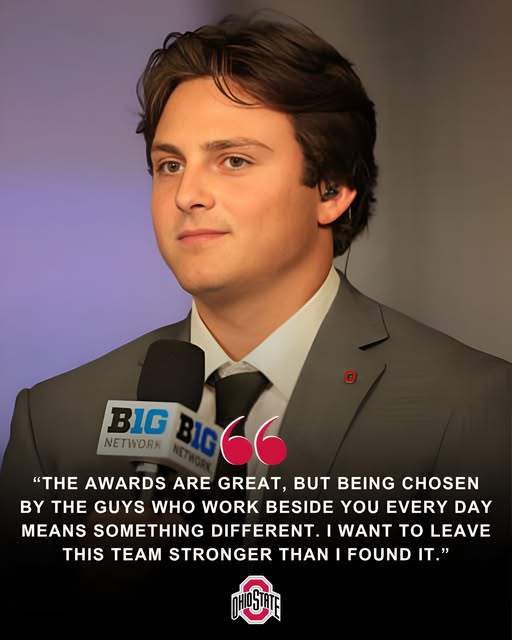
“I want to leave this team stronger than I found it,” Sayin said, a simple statement that has begun to reflect the way teammates and younger players view his role inside the program.
As Ohio State prepares for another season carrying championship-level expectations, Sayin has quietly expanded his influence beyond the quarterback room. Coaches and players around the program have noticed a more vocal presence, but perhaps more importantly, a quarterback increasingly willing to invest time in the development of the Buckeyes around him.
That maturation matters for a program where the standard is not simply winning games. At Ohio State, the quarterback position is often the center of the sport’s most intense scrutiny, responsible for setting the offensive tempo while simultaneously representing one of college football’s most visible brands.
Sayin appears to understand that the job description extends beyond Saturdays.
The 2026 Buckeyes are entering a critical phase of roster development, with younger players being asked to grow quickly and established veterans expected to maintain the competitive culture that has defined the program. In that environment, Sayin’s willingness to take younger teammates under his wing has emerged as an important storyline during the offseason.
For a quarterback, leadership often reveals itself in small moments long before it becomes visible in a stadium.
It can be found in extra film sessions, in conversations after practice, in helping a young receiver understand the details of route timing or spending additional time with a freshman learning the complexity of a college offensive system. Quarterbacks operate at the intersection of nearly every offensive position, and the best ones eventually learn that developing trust is just as important as mastering the playbook.
Sayin’s increased presence appears to be rooted in that understanding.
The Buckeyes have long placed enormous demands on their quarterbacks. From C.J. Stroud to Justin Fields, Dwayne Haskins and other recent stars, Ohio State’s offense has produced quarterbacks capable of operating sophisticated passing attacks while handling the expectations that accompany competing for Big Ten and national championships.
That history creates opportunity, but it also creates pressure.
Every Ohio State quarterback is measured against both the current season and the program’s past. Completion percentage, explosive-play production, touchdown-to-interception ratio and efficiency on third down all become part of the weekly conversation. In the modern game, evaluators also look deeper, examining yards per attempt, expected points added, success rate and performance against pressure.
Yet some of the most important traits are more difficult to quantify.
A quarterback’s command of a huddle cannot be reduced entirely to a statistic. Neither can his ability to steady an offense after a turnover, correct protection issues at the line of scrimmage or build confidence in a young receiver who has struggled through an inconsistent practice.
Those responsibilities are becoming a larger part of Sayin’s identity.
The timing is significant for Ohio State. College football’s changing roster landscape has made continuity increasingly difficult to sustain. The transfer portal, NIL opportunities and the NFL Draft have created a sport in which teams can undergo significant roster turnover from one season to the next. Programs must now develop players while also continuously managing retention and replacing departing talent.
That makes internal leadership more valuable.
Ohio State has consistently recruited at an elite level, but recruiting rankings alone do not build cohesion. A locker room with blue-chip prospects still requires players willing to teach, communicate and establish accountability.
For Sayin, the transition toward becoming one of those voices represents a natural next step.
The quarterback position is uniquely suited to influence the daily culture of an offense. The signal-caller is responsible for understanding the full structure of the scheme, from pre-snap identification to post-snap coverage recognition. He must recognize defensive leverage, identify potential pressure packages and communicate adjustments to the offensive line and skill players.
But technical command is only one part of the equation.
A quarterback can know every protection call and still struggle to lead if teammates do not trust him. Conversely, the quarterbacks who become the emotional center of an offense usually establish credibility through preparation and consistency.
That is where Sayin’s approach entering 2026 could become particularly important.
Rather than attempting to manufacture a personality that does not fit him, Sayin appears to be embracing a leadership style built around presence and investment. The growth of a quarterback does not always require becoming the loudest player on the roster. Some leaders command a room through speeches. Others earn influence through the consistency of their work and the relationships they build with teammates.
For Sayin, the latter approach could prove just as powerful.
Ohio State coach Ryan Day has spent years emphasizing the importance of quarterback development and preparation. His background as a quarterbacks coach and offensive strategist has made the position central to the program’s identity. Under Day, Ohio State has consistently pursued quarterbacks capable of making high-level throws while processing defenses quickly enough to operate an offense designed to create mismatches across the field.
The Buckeyes’ system places a premium on precision.
Receivers and quarterbacks must be aligned on coverage adjustments. Protection calls must account for simulated pressures and late movement from opposing defenses. Timing concepts require quarterbacks to release the football before receivers make their breaks, particularly against the tight man coverage and disguised coverages common at the highest levels of college football.
A quarterback’s leadership can accelerate that entire process.
If Sayin continues to build stronger relationships with younger receivers, linemen and skill players, the benefits could eventually show up in the details that decide close games. Better communication can reduce assignment errors. Greater familiarity can improve scramble-drill chemistry. Trust can help an inexperienced player recover more quickly after making a mistake.
Those advantages do not guarantee victories, but championship teams are often separated by margins that small.
The stakes surrounding Ohio State in 2026 remain substantial. The Buckeyes are expected to operate in the national championship conversation every season, and the expanded College Football Playoff has increased the importance of both depth and durability. A team no longer necessarily needs to navigate only a handful of high-stakes postseason games. The path to a championship can require surviving a longer playoff run against elite competition.
That places even greater importance on the quarterback’s ability to sustain an offense through adversity.
A young quarterback may be able to win with talent. An experienced leader must often win through adjustment.
That distinction will be worth monitoring with Sayin.
Defenses will continue searching for ways to disrupt Ohio State’s offensive rhythm. Opponents will test protection schemes, disguise coverage and attempt to force the quarterback into difficult decisions after the snap. The ability to diagnose those looks will be essential, but so will the ability to keep an entire offense composed when the original plan is no longer working.
Sayin’s growing leadership role could prepare him for precisely those moments.
The ripple effect could also extend beyond one season.
Ohio State’s program has traditionally benefited from a culture in which veteran players pass institutional knowledge to younger teammates. In an era of accelerated roster movement, preserving that culture has become more challenging. Every player who leaves takes experience with him. Every incoming freshman must learn not only the playbook but also the expectations that come with playing at a program of Ohio State’s stature.
Sayin’s investment in younger Buckeyes could help bridge that gap.
For the players around him, having a quarterback willing to explain, encourage and demand accountability can speed up the transition from recruiting prospect to contributor. It can also strengthen the continuity of the quarterback room, one of the most strategically important groups in any program.
That broader impact may ultimately become part of Sayin’s legacy.
The NFL is watching, too.
Professional scouts evaluate quarterbacks through a wide lens that extends beyond arm strength and highlight throws. They study pocket movement, processing speed, anticipation, accuracy under pressure and decision-making. They also spend significant time investigating leadership, competitiveness and the ability to command a locker room.
College production remains important, but teams investing premium draft capital in a quarterback are attempting to identify a player capable of becoming the organizational center of a franchise.
The leadership development Sayin is demonstrating at Ohio State could eventually become part of that evaluation.
There is, of course, a long distance between becoming a respected leader in a college locker room and succeeding as an NFL quarterback. The professional game presents a different level of complexity, and Sayin’s ultimate draft trajectory will depend heavily on his performance, development and ability to produce against elite competition.
But the traits he is cultivating now are relevant.
Quarterbacks are judged by wins and losses, touchdowns and turnovers, championships and draft position. Those measurements will always matter. Yet the players who leave the deepest imprint on programs are often remembered for what they gave to teammates as much as what they accomplished statistically.
Sayin appears to be embracing that larger responsibility.
His statement — “I want to leave this team stronger than I found it” — is not a promise that can be measured immediately in a box score. Its meaning will be revealed over time, through the development of younger players, the cohesion of Ohio State’s offense and the standard that remains when his own playing career in Columbus eventually comes to an end.
For now, though, the signs of change are drawing attention.
Julian Sayin entered Ohio State as one of the nation’s most celebrated quarterback prospects. Entering the 2026 season, the expectations surrounding his talent have not disappeared.
But inside the Buckeyes’ program, something else is beginning to define him.
He is no longer simply preparing to lead an offense.
He is learning how to lead a program.
And for Ohio State, a team built around championship expectations and an ever-changing roster, that development could become just as important as any throw Sayin makes this fall.