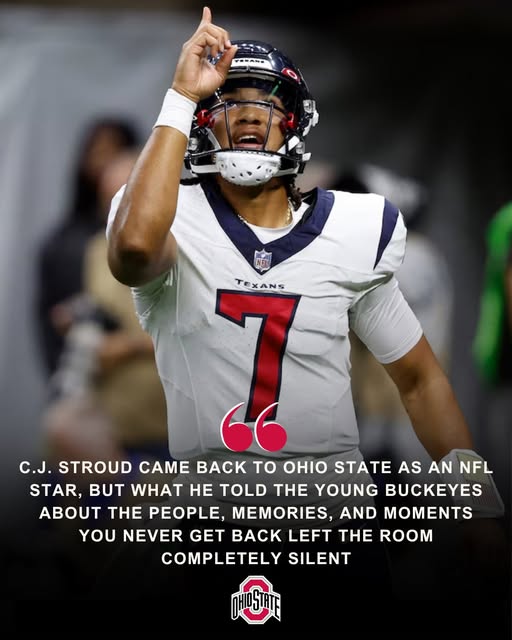
COLUMBUS, Ohio — C.J. Stroud did not need a stage, a microphone or a carefully choreographed social-media announcement to make an impact when he returned to Ohio State.
The former Buckeyes quarterback, now one of the NFL’s most recognizable young passers, quietly spent time around current Ohio State players during a return to Columbus, sharing lessons from his transition from college football to the professional game and reconnecting with the program that helped launch his career.
For Stroud, the visit represented something more significant than a former star stopping by his old campus.
It was another reminder that his connection to Ohio State has continued long after he left Columbus, declared for the NFL draft and became the Houston Texans’ franchise quarterback. The faces have changed. The locker room has turned over. Coaches, teammates and recruiting classes have moved through the program. But Stroud’s relationship with Ohio State remains intact.
And for current Buckeyes, there are few better examples of what the path from Columbus to the NFL can look like.
Stroud arrived at Ohio State as a highly regarded quarterback prospect from Southern California, but his climb to the top of the college football landscape was not immediate. He spent his first season learning behind Justin Fields before taking over as the Buckeyes’ starting quarterback in 2021.
What followed was one of the most productive two-year stretches by a quarterback in program history.
In 2021, Stroud threw for 4,435 yards and 44 touchdowns while helping Ohio State produce one of the nation’s most explosive offenses. He followed that with another elite campaign in 2022, throwing for 3,688 yards and 41 touchdowns. Across 25 career starts, Stroud completed 69.3% of his passes, threw 85 touchdown passes against only 12 interceptions and finished with 8,123 passing yards.
The statistics only tell part of the story.
Stroud developed into one of college football’s most polished pocket passers, combining high-level accuracy with anticipation, touch and the ability to attack every level of the field. Ohio State’s offense asked him to make full-field reads, manipulate coverage structures and deliver throws before receivers had fully separated.
Those traits became increasingly important as NFL evaluators studied his transition from Ryan Day’s quarterback-friendly system to the professional game.
Perhaps the defining performance of Stroud’s Ohio State career came in the College Football Playoff semifinal against Georgia following the 2022 season. Facing one of the nation’s most talented defenses, Stroud threw for 348 yards and four touchdowns and added a dimension that critics had wanted to see: off-schedule creation.
He extended plays, escaped pressure and consistently made difficult throws against an NFL-caliber defense. Ohio State ultimately lost 42-41 on a missed field goal in the closing seconds, but Stroud’s performance strengthened the argument that he possessed more than enough athletic and creative ability to succeed at the next level.
Months later, the Houston Texans selected him with the No. 2 overall pick in the 2023 NFL draft.
The transition was immediate, and the results were historic.
Stroud threw for 4,108 yards, 23 touchdowns and five interceptions as a rookie, earning NFL Offensive Rookie of the Year honors and helping transform expectations around a Houston franchise that had entered the season in the middle of a rebuilding process. His poise from the pocket, willingness to challenge defenses vertically and efficiency against pressure quickly established him as one of the league’s most promising young quarterbacks.
The Texans’ postseason victory over the Cleveland Browns added another chapter to Stroud’s rapid ascent, as Houston advanced behind an offense that had found its long-term centerpiece.
For the Buckeyes watching from Columbus, Stroud had become another example of Ohio State’s ability to develop quarterbacks capable of entering the NFL as franchise-level prospects.
That context made his recent return particularly meaningful.
Current players are not simply hearing advice from a former All-American whose college career ended years ago. They are learning from someone who has experienced the uncertainty surrounding an NFL draft, the pressure of becoming a high draft pick and the challenge of immediately being asked to lead an NFL locker room.
The gap between college football and the NFL is often discussed in terms of speed and physicality, but the mental transition can be equally demanding.
NFL defenses disguise coverages more effectively. Pass-rush plans are more sophisticated. Every opponent has elite athletes. A quarterback must understand protection adjustments, identify pressure indicators before the snap and process coverage rotations in fractions of a second.
Stroud has lived that adjustment.
His message to Ohio State players carries additional weight because his career did not follow a perfectly smooth line. He dealt with expectations that accompany being Ohio State’s quarterback, the scrutiny surrounding the Buckeyes’ annual championship ambitions and the disappointment of falling just short of a national championship appearance.
Those experiences can be more valuable to young players than generic encouragement.
The current Buckeyes understand the expectations attached to wearing the Ohio State uniform. Every season begins with national championship aspirations. Every quarterback is measured against the program’s recent history. Every loss can become a referendum on the team, the coaching staff and the direction of the program.
Stroud knows that environment.
He also knows what it means to leave it.
The relationship between former players and their college programs can often become ceremonial once an NFL career begins. A player returns for a spring game, receives recognition at a major event or appears in recruiting materials. Stroud’s continued connection, however, speaks to a broader culture within the program.
Ohio State has long benefited from a network of former players who remain connected to the university and its football program. For current athletes, those relationships create an informal bridge between different eras of the Buckeyes’ history.
A young quarterback can study Stroud’s college tape, but sitting down with him offers something film cannot provide.
There is value in hearing how he prepared for an opponent, handled criticism or adjusted after a difficult game. There is value in understanding what surprised him during his first NFL training camp and how his preparation changed once every defensive coordinator began building a weekly game plan around taking away his strengths.
Those conversations matter in an era when college football has become increasingly transactional.
The transfer portal and NIL have changed roster construction, while conference realignment has altered the sport’s competitive map. Players now have more freedom and more opportunities, but programs also face the challenge of maintaining continuity and institutional identity.
Former players can help provide that continuity.
Stroud’s presence offers Ohio State’s current roster a direct connection to a recent era when the Buckeyes were competing annually for College Football Playoff positions and producing elite NFL talent. His journey also reinforces the reality that development does not end with recruiting rankings.
At Ohio State, Stroud grew from a talented prospect into one of the country’s premier quarterbacks. In Houston, he has continued the process against significantly more complex defenses and greater weekly pressure.
That evolution is particularly relevant to the modern NFL landscape.
The quarterback market has become increasingly expensive, with elite veterans commanding massive portions of a team’s salary cap. The financial advantage of having a productive quarterback on a rookie contract can dramatically accelerate a franchise’s rebuilding timeline, allowing organizations to invest resources elsewhere on the roster.
Houston benefited from that model after drafting Stroud.
A young quarterback playing at a high level on a rookie deal can create flexibility to add talent around him, strengthen the offensive line, improve the defense and extend the competitive window before the quarterback becomes eligible for a market-changing extension.
For the Texans, that has made Stroud’s development more than a personal success story. It has become central to the franchise’s team-building strategy.
For Ohio State, his NFL emergence has also become part of the program’s larger recruiting and development case.
The Buckeyes can point to Stroud’s career as evidence that a quarterback can enter Columbus, compete against elite competition, operate an advanced passing offense and leave prepared for the demands of the NFL. That matters as Ohio State continues competing for top quarterback prospects in an increasingly aggressive recruiting landscape.
Still, the most meaningful part of Stroud’s return may have had little to do with recruiting or NFL economics.
It was about connection.
The NFL can quickly pull players away from the places where their careers began. Training schedules, offseason programs, endorsement responsibilities and the constant demands of professional football leave limited time for reflection.
Yet Stroud’s return to Columbus offered current players a chance to learn from someone who once occupied the same meeting rooms, practiced on the same fields and carried many of the same expectations.
His story has moved well beyond Ohio State.
But Ohio State remains part of the story.
For a program preparing another generation of players to chase championships and NFL careers, that connection carries real value. Stroud’s quiet return was not about reliving old highlights or turning a visit into a spectacle.
It was about giving back to the place that helped prepare him for the biggest stage in football.
And for the Buckeyes who listened, the message may have been simple: The journey to the NFL can begin in Columbus, but the lessons learned there do not have to end when a player leaves.
C.J. Stroud’s career is proof of that. His return home was a reminder of it.