“I Want to Leave This Team Stronger Than I Found It”: Julian Sayin Quietly Embraces a Bigger Leadership Role as Ohio State’s 2026 Season Approaches
The most important development in Ohio State’s quarterback room this offseason may have nothing to do with arm strength, recruiting rankings or the outcome of a seven-on-seven period.
It may be Julian Sayin’s voice.
As the Buckeyes prepare for the 2026 season, Sayin has quietly begun embracing a larger leadership role inside the program, taking a more active hand in guiding younger players and helping establish the standards expected in one of college football’s most demanding environments. The former blue-chip quarterback arrived in Columbus carrying enormous expectations. Now, with another season of experience and a deeper understanding of what Ohio State requires from its quarterback, Sayin appears increasingly focused on what he can leave behind.
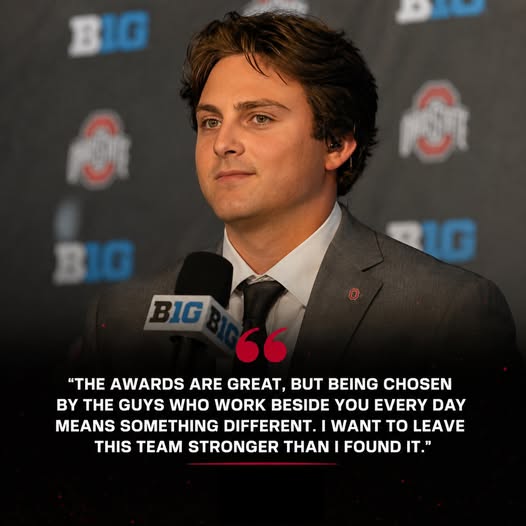
“I want to leave this team stronger than I found it,” Sayin’s approach to the offseason can be summed up in a message that reflects a changing responsibility for a player whose role is expanding beyond simply executing the offense.
For Ohio State, that evolution matters.
Quarterback leadership is not measured only by touchdown passes or completion percentage. Inside elite programs, the position carries another responsibility: setting the emotional temperature of the offense, controlling the pace of preparation and becoming a stabilizing presence when the pressure surrounding the program inevitably rises.
The Buckeyes have never lacked talent. Their challenge entering 2026 is ensuring that talent functions as a connected football team.
That is where Sayin’s growing influence has begun to attract attention.
Ohio State’s quarterback room has long operated under an unusual level of scrutiny. From C.J. Stroud and Justin Fields to the generations of highly ranked passers who have competed for the starting job, every quarterback in Columbus is evaluated against championship expectations. The position is not simply about winning games. It is about navigating a schedule that annually includes national championship ambitions, a physical Big Ten grind and the sport’s most emotionally charged rivalry.
For Sayin, the transition from highly regarded recruit to experienced voice inside the locker room represents another stage in that process.
His natural talent was never the question.
Sayin entered the college game with the kind of pedigree that follows elite quarterback prospects from the recruiting circuit into the national spotlight. His mechanics, release quickness and ability to process defensive structures made him one of the most discussed young quarterbacks of his recruiting class. But recruiting evaluations, no matter how glowing, do not prepare a quarterback for the daily demands of leading an Ohio State offense.
The adjustment requires learning how to command protections against disguised pressure, recognize late safety rotation and understand when a defense is attempting to manipulate the quarterback’s eyes. It also requires developing the interpersonal side of the position.
The quarterback must know when to challenge a teammate.
He must also know when to listen.
That distinction becomes particularly important for a player like Sayin as younger Buckeyes enter the program. Ohio State continues to recruit at an elite level, meaning the quarterback room and surrounding offensive roster are regularly populated by players accustomed to being the best athletes on their previous teams.
The adjustment from high school star to Ohio State contributor can be difficult.
Sayin appears increasingly aware of that reality.
Rather than allowing the competition within the program to create distance between established players and newcomers, his expanding leadership role has centered on helping younger Buckeyes understand the routine required to survive and eventually thrive at the college level.
That can mean extra film work. It can mean helping a young receiver understand how route timing changes against press coverage. It can mean communicating the importance of recognizing defensive leverage before the ball is snapped.
Sometimes, it is simply setting an example.
Those details are often invisible to fans, but they can determine whether an offense develops continuity by October or spends an entire season trying to find it.
Ohio State coach Ryan Day has built his reputation around quarterback development and offensive structure. The Buckeyes’ system places significant mental responsibility on the player under center. Modern defenses have become increasingly sophisticated in how they disguise coverage, rotate safeties and manufacture pressure without committing additional defenders.
A quarterback cannot simply identify man or zone coverage and throw to his first read.
He must process the entire picture.
That includes identifying the front, locating potential pressure, setting the protection and understanding how the defense’s post-snap movement affects the progression. On passing downs, the margin for error can become especially small against opponents capable of generating pressure with four defenders while dropping seven into coverage.
The quarterback who can remain calm in those situations can change an offense.
The quarterback who panics can destroy one.
Sayin’s development as a leader therefore runs parallel to his development as a passer. The two responsibilities are connected. A quarterback who understands the offense well enough to teach it is often better positioned to command it when the game becomes chaotic.
That is particularly important entering a season in which Ohio State will again operate under championship-level expectations.
The Buckeyes do not measure success simply by reaching a bowl game. Their standard is the College Football Playoff. Every season begins with the expectation that Ohio State possesses the recruiting base, infrastructure and talent necessary to compete with the sport’s best programs.
That expectation creates pressure, but it also creates opportunity.
For Sayin, 2026 could become a defining stage in his development. The question is no longer only whether he possesses the physical traits to lead an elite offense. The question is whether he can become the type of quarterback who elevates the players around him.
That is a different evaluation.
The NFL has increasingly valued quarterbacks who can control more than the passing game. Front offices study processing speed, pressure response, third-down efficiency and performance against complex coverage structures. But leadership remains one of the more difficult qualities to quantify.
A quarterback can produce impressive raw statistics and still struggle to command an offense.
Conversely, a player whose numbers do not immediately jump off the page can become indispensable because of his command at the line of scrimmage, preparation habits and ability to maintain composure when momentum turns.
That broader evaluation will eventually matter for Sayin as his football career progresses.
But for now, the focus is Ohio State.
The Buckeyes enter the 2026 season facing the familiar challenge of replacing experience while maintaining championship expectations. College football’s transfer portal and NIL era have transformed roster construction, making continuity increasingly valuable. Teams can add veteran talent quickly, but leadership chemistry cannot always be acquired through a transaction.
It has to be built.
That is why the development of internal leaders can be as important as landing a five-star recruit or securing a major transfer.
Ohio State’s younger players need examples of how preparation is supposed to look. They need to see how veteran players respond after a difficult practice, a turnover or a disappointing performance. They need to understand that the difference between a talented team and a championship contender is frequently revealed in the moments when nobody is watching.
Sayin’s growing involvement with those players could help establish that foundation.
The timing is also significant for the Buckeyes’ offense.
Modern college football increasingly rewards quarterbacks capable of extending plays without abandoning structure. The best offenses create explosive plays through scheme, but they also rely on quarterbacks who understand when to take the available completion rather than forcing a dangerous throw into coverage.
Efficiency matters.
Third-down conversion rate matters.
Red-zone execution matters.
Ball security matters.
A quarterback who can combine explosive-play potential with disciplined decision-making gives an offense flexibility. It allows coordinators to attack defenses vertically while still maintaining answers against pressure and coverage variation.
For Ohio State, Sayin’s continued growth could influence every layer of that equation.
His relationship with younger receivers and offensive players may also become particularly important as the season develops. Timing between a quarterback and receiver is not created exclusively through formal practice periods. The best passing combinations develop a shared understanding of body language, leverage and anticipation.
A receiver may recognize Cover 2 and expect the quarterback to hold the safety before attacking the sideline.
The quarterback must trust that the receiver will adjust his route accordingly.
Those small moments become the difference between a completion and an interception.
Leadership can accelerate that process because communication creates trust.
The larger challenge, however, will be maintaining that influence when adversity arrives.
Every quarterback can lead when the offense is scoring 45 points.
The more meaningful test comes after consecutive three-and-outs, a fourth-quarter interception or a loss that sends the college football world searching for explanations. Ohio State quarterbacks operate in one of the sport’s most demanding environments. The reaction to every major decision can become national news.
Sayin will not be immune to that scrutiny.
What he can control is his response.
That may ultimately be the most significant aspect of his expanding leadership role. He is learning that the quarterback position requires more than preparing for Saturday. It requires creating an environment that helps everyone else prepare as well.
The strongest leaders do not simply demand accountability. They demonstrate it.
For Ohio State, that distinction could carry considerable value entering 2026.
The Buckeyes remain one of the programs capable of influencing the national championship race. Their recruiting reach, resources and established infrastructure ensure that they will again be evaluated against the best teams in the country. The Big Ten’s continued place at the center of the College Football Playoff picture only increases the importance of stability at quarterback.
A talented quarterback can win games.
A mature quarterback can help sustain a season.
And a quarterback capable of developing the players around him can help define the future of a program.
Sayin appears to understand that responsibility more clearly now.
His desire to leave Ohio State “stronger than I found it” is not the language of a player concerned only with his own development or eventual professional opportunities. It reflects a broader understanding of what the position demands at a program where expectations extend beyond individual accomplishment.
The 2026 season will ultimately judge Sayin by what happens between the lines. His production, decision-making, ability to handle pressure and performance in Ohio State’s biggest games will determine how his season is remembered.
But the work taking place before kickoff could prove just as important.
Inside a quarterback room, leadership is rarely announced.
It is noticed.
And as Ohio State moves closer to another season filled with championship expectations, Sayin’s teammates are beginning to notice.