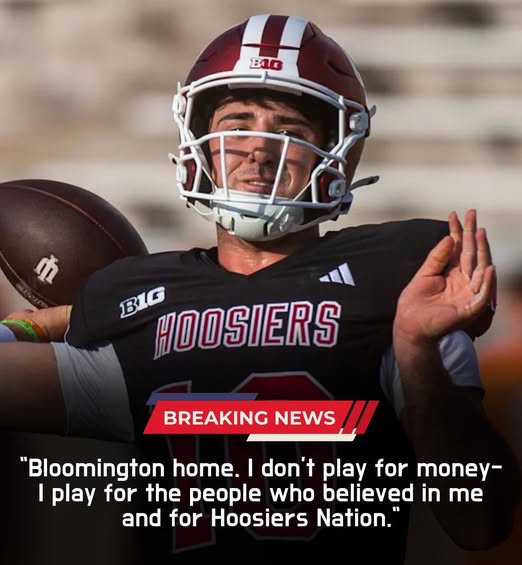
In a development that has quickly stirred conversation across college football and the wider sports business landscape, Mark Cuban has publicly claimed that he personally “put up the money” to help secure the arrival of quarterback Fernando Mendoza at Indiana University, a statement that adds a high-profile financial twist to one of the program’s most closely watched roster moves in recent memory.
Speaking in a recent media appearance that has since circulated widely among fans and analysts, Cuban suggested he played a direct financial role in supporting Indiana’s pursuit of Mendoza, a quarterback transfer whose recruitment had already been generating attention inside the college football transfer portal ecosystem. While Cuban did not provide a detailed breakdown of the arrangement, his comments implied involvement in the evolving Name, Image, and Likeness (NIL) landscape that continues to reshape how elite college programs build competitive rosters.
“I put up the money to get him there,” Cuban said, according to the remarks being widely shared, referencing Mendoza’s move to the Hoosiers. The claim immediately sparked debate over the growing influence of wealthy boosters, entrepreneurs, and private financiers in college athletics, particularly in football programs looking to accelerate their rebuilds through the transfer portal.
Indiana’s football program, representing Indiana Hoosiers, has been working aggressively to reposition itself within the Big Ten hierarchy, and the addition of Mendoza has been viewed as part of a broader effort to strengthen the quarterback room with high-upside talent capable of changing the trajectory of the team’s offense. While the university has not issued any formal statement confirming Cuban’s specific financial involvement, the quarterback’s arrival has already been confirmed through standard program announcements earlier in the offseason.
Mendoza, a talented signal-caller with a growing reputation for arm strength, poise under pressure, and developmental upside, entered the transfer portal amid significant interest from multiple programs. His decision to land at Indiana was initially framed as a football-driven choice, influenced by depth chart opportunity, coaching relationships, and offensive scheme fit. However, Cuban’s comments have now introduced a new layer to the narrative, raising questions about how NIL resources may have factored into the decision-making process.
College football’s NIL era has made it increasingly common for high-profile alumni, boosters, and outside investors to contribute financially to collectives that support student-athletes. What makes Cuban’s claim particularly notable is not merely the financial involvement itself, but the directness of his statement and his prominence as a billionaire entrepreneur and former NBA franchise owner of the Dallas Mavericks. His public acknowledgment of funding a specific player acquisition blurs the line between private NIL support and perceived recruitment influence, a topic already under scrutiny from regulators and conferences.
For Indiana, the arrival of Mendoza represents both an on-field investment and a symbolic step in its ambition to compete more consistently with established Big Ten powers. The Hoosiers have spent recent seasons cycling through quarterback options, searching for stability and explosive playmaking ability to match the offensive demands of modern conference competition. Mendoza’s profile fits the mold of a developmental quarterback with starter potential, and coaching staff members have reportedly been high on his long-term ceiling since his recruitment process began.
While Cuban’s comments have amplified attention on the financial side of the deal, Indiana’s internal focus remains on football performance. Sources close to the program have indicated that Mendoza’s integration into the offensive system has been progressing steadily, with spring and summer evaluations emphasizing timing, decision-making, and adaptation to collegiate defensive speed. Coaches have reportedly emphasized simplifying reads early in his development while gradually expanding his responsibilities within the playbook.
Still, the broader implications of Cuban’s remarks extend beyond Bloomington. Across college athletics, the NIL era has created a decentralized financial ecosystem in which third-party collectives, boosters, and private donors play an increasingly influential role in recruiting and retention. While NCAA rules prohibit direct pay-for-play arrangements in theory, enforcement and interpretation have become complex, particularly as athletes are compensated through endorsements, marketing agreements, and collective-driven partnerships.
Cuban’s statement will likely reignite ongoing discussions about transparency and regulation within NIL structures. Critics argue that the current system allows for competitive imbalance, as programs with access to wealthier donor bases can more easily assemble competitive NIL packages to attract top talent. Supporters, however, contend that athletes should benefit from their market value and that NIL simply modernizes long-standing realities of college sports economics.
For Mendoza, the focus remains on football development rather than off-field narratives. The quarterback position at Indiana carries significant weight, particularly as the program seeks to climb in a conference dominated by perennial contenders. His arrival has been framed internally as part of a long-term investment in offensive identity, with expectations centered on growth rather than immediate stardom.
Analysts familiar with Indiana’s roster construction have pointed out that quarterback development has often been the missing piece in the program’s efforts to break through in Big Ten competition. While the Hoosiers have produced competitive defenses and moments of offensive promise, consistency at the quarterback position has remained elusive. Mendoza’s skill set is seen as an attempt to address that gap with a more dynamic and adaptable passer.
Cuban’s involvement, whether symbolic or materially significant, also reflects a broader trend of high-profile business figures becoming more openly engaged in collegiate athletics. As NIL collectives continue to evolve, the line between fandom, investment, and influence is becoming increasingly blurred. In some cases, donors view their contributions as support for student-athlete empowerment; in others, it is seen as strategic investment in program success.
What remains unclear is the exact structure of the financial arrangement Cuban referenced. He did not specify whether his contribution went directly to Mendoza, through an NIL collective affiliated with Indiana, or as part of a broader funding pool supporting multiple athletes. That ambiguity is central to ongoing debates about NIL transparency, as stakeholders across the sport call for clearer guidelines and reporting standards.
Indiana officials have remained measured in their public response, focusing instead on roster preparation and competitive outlook. Within the athletic department, the emphasis is reportedly on ensuring compliance with NCAA NIL guidelines while maximizing opportunities for athletes to benefit from legitimate marketing and endorsement deals.
For fans, however, Cuban’s comments have added a layer of intrigue to what was already an important roster addition. Indiana supporters have long been eager to see the program make bold moves in recruiting and the transfer portal, and Mendoza’s arrival represents one of the more significant quarterback acquisitions in recent memory. The added attention from Cuban’s statement has only heightened expectations heading into the upcoming season.
Across the broader college football landscape, rival programs are also likely to take notice. The idea that a figure of Cuban’s stature is willing to publicly associate himself with funding a quarterback acquisition underscores how competitive and high-stakes roster building has become. It also raises questions about how programs without similar access to wealthy supporters will keep pace in an increasingly monetized environment.
At the same time, there is recognition that player development, coaching, and system fit remain central to success on the field. No amount of financial support guarantees performance, and Indiana’s coaching staff will ultimately be judged on how effectively Mendoza transitions into game action and executes within the offense.
As the season approaches, attention will gradually shift from the financial headlines to football outcomes. Mendoza’s performance will be scrutinized through the lens of Indiana’s offensive efficiency, win-loss progression, and competitiveness within conference play. Cuban’s remarks, while headline-grabbing, will eventually become part of the broader narrative rather than the defining feature of Mendoza’s collegiate career.
Still, the intersection of celebrity investment and college athletics is unlikely to fade anytime soon. With figures like Mark Cuban increasingly vocal about their involvement in the NIL space, college football continues to evolve into a hybrid landscape of sport, business, and personal branding at an unprecedented scale.
For Fernando Mendoza, the opportunity now lies in transforming expectation into execution. For Indiana University and the Indiana Hoosiers, the challenge is turning high-profile acquisitions into on-field results. And for the broader college football world, Cuban’s comments serve as yet another reminder that the modern game is being shaped not only by coaches and athletes, but by the powerful financial forces operating just beyond the sidelines.