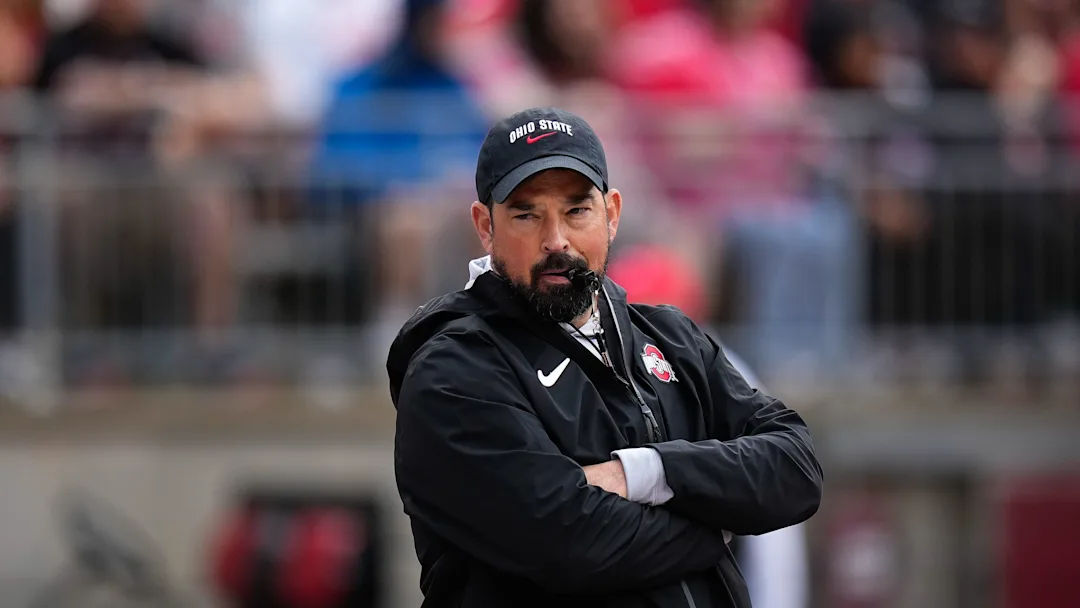
COLUMBUS, Ohio — In the modern era of college football recruiting, where Name, Image and Likeness deals, transfer portal movement, and social media branding often shape as much of a prospect’s decision-making as depth charts and development plans, Ryan Day is not pretending otherwise. The Ohio State head coach has a message for recruits considering the program, and it is as direct as it is uncompromising: if you are not fully committed to competing at the highest standard every single day, this is not the place for you.
Day’s tone, according to people familiar with his approach in recent recruiting conversations, has been increasingly firm as he and the Ohio State Buckeyes continue to operate under the pressure that comes with being one of college football’s flagship programs. Ohio State is not rebuilding. It is not rebranding. It is expected to win Big Ten championships and contend for national titles every year. And in Day’s view, that expectation is not something recruits should simply admire from afar—it is something they must be prepared to live up to immediately upon arrival.
The message is not framed as a warning in the traditional sense. It is more of a filter. A self-selection mechanism. If a prospect is looking for comfort, guaranteed playing time, or a soft landing into college football, Day has made it clear those expectations will clash with reality in Columbus. The standard is competition, and it begins the moment a recruit considers signing with Ohio State.
Day’s bluntness stems from the evolution of the sport itself. College football is no longer just about identifying talent; it is about managing expectations in a system where roster movement is constant and development windows are shorter than ever. For Ohio State, a program that routinely sends players to the NFL and reloads with top-tier recruiting classes, there is little room for players who are unsure about the grind that comes with being elite.
Recruiting pitches across the country have become increasingly polished, filled with promises of opportunity, exposure, and branding potential. But Day’s approach has leaned in the opposite direction. Instead of selling a dream, he has been emphasizing reality. At Ohio State, he reportedly tells recruits, nothing is guaranteed—except competition.
That philosophy is not new, but its urgency has intensified. With the transfer portal creating an exit ramp for dissatisfied players and NIL opportunities adding financial complexity to roster decisions, programs like Ohio State must ensure they are not simply attracting talent, but attracting the right mindset. Day has been vocal internally about avoiding what he perceives as roster fragility—players who may be highly ranked but are not prepared to withstand the internal competition required to sustain championship-level football.
For Ohio State, that internal competition is not symbolic. It is structural. Position rooms are typically stacked with former five-star recruits, returning starters, and early enrollees all fighting for limited snaps. In that environment, Day’s message to recruits is simple: if you are not comfortable being pushed every day, you will not survive here.
Sources around the program describe Day’s recruiting conversations as increasingly transparent. He does not shy away from discussing depth charts, even when they are crowded. He does not overpromise playing time, even when a recruit is highly ranked. And he does not hesitate to challenge a prospect’s mindset if he senses hesitation.
That approach reflects a broader cultural shift within the program. Ohio State has long recruited itself as one of the premier destinations in college football, but Day has worked to refine what that prestige actually demands. The expectation is not just to join the program—it is to elevate it. That means understanding that being a Buckeye comes with daily scrutiny, both internal and external.
Day’s blunt messaging also reflects lessons learned from recent seasons, where Ohio State has remained among the nation’s elite but has fallen short of its ultimate goal of winning a national championship. In those moments, the margins have often been thin, and internal resilience has been tested. The conclusion within the program has been that talent alone is not enough. Mental toughness, consistency, and competitive urgency must match it.
Recruiting, therefore, is no longer just about identifying athletic upside. It is about identifying psychological durability.
That shift is particularly important in the NIL era. While Ohio State is among the most competitive programs in the country in terms of NIL infrastructure and opportunities, Day has made it clear that financial incentives cannot be the foundation of a recruit’s decision. In his conversations, NIL is acknowledged but not emphasized. The core message remains development, competition, and NFL preparation.
For many recruits, that honesty is refreshing. In an environment where some programs are accused of overselling roles or minimizing competition to secure commitments, Day’s approach stands out for its clarity. He is effectively telling prospects: you will earn everything here, or you will not last.
Within recruiting circles, that reputation has become part of Ohio State’s identity. Some prospects are drawn to it, viewing the challenge as validation of their own confidence. Others, however, are deterred by it, preferring environments where the pathway to playing time appears more immediate. Day appears comfortable with both outcomes. His priority is not volume of commitments—it is alignment.
That alignment extends beyond the field. Ohio State’s coaching staff has also placed greater emphasis on evaluating how recruits handle adversity, feedback, and internal competition during unofficial visits and camp settings. A player’s response to being coached hard, corrected, or placed in uncomfortable drills has become just as important as their highlight tape.
The message is consistent: Ohio State is not a program that protects players from pressure. It is a program that applies it.
This philosophy has also shaped how the Buckeyes approach roster management. The coaching staff has embraced the idea that not every highly rated recruit will stay, and not every early contributor will remain in a starting role. Instead of resisting that volatility, Day has leaned into it, reinforcing that the program’s standard is independent of individual timelines.
For recruits, that means entering an environment where patience and performance must coexist. For some, that is an appealing challenge. For others, it is a deterrent. But for Ohio State, it is intentional.
Day’s approach also reflects the broader expectations that come with leading one of the most scrutinized programs in the country. Every recruiting class is evaluated not just on rankings, but on how it translates to on-field success in playoff environments. Every depth chart decision is analyzed in real time by a national audience. Every perceived misstep becomes a talking point.
In that context, his blunt messaging is not just philosophical—it is strategic. By being direct early in the recruiting process, Ohio State aims to reduce attrition, stabilize locker room dynamics, and ensure that those who commit are prepared for the realities of the program.
The long-term goal is roster cohesion under pressure. Day has repeatedly emphasized that championship teams are not defined by their best players, but by their willingness to compete internally without fragmentation. That requires recruiting players who understand and accept that they will not be handed anything.
Even as recruiting remains the lifeblood of college football success, Ohio State’s approach under Day signals a shift away from purely transactional relationships. Instead, it is increasingly about mutual accountability. The program invests heavily in a recruit’s development, but it expects full commitment in return—no hesitation, no conditional loyalty, and no expectation of entitlement.
As the Buckeyes continue to pursue elite classes nationally, Day’s message is likely to remain consistent. It is not designed to appeal to everyone. It is designed to identify the few who can thrive in an environment where expectations never soften.
For Ohio State, that clarity is the point. The standard does not change. The competition does not pause. And according to Day, neither should a recruit’s decision-making process.
If a prospect is looking for certainty, he suggests they look elsewhere. But if they are looking for the chance to prove themselves daily at one of college football’s highest levels, then they already understand what Ohio State demands before they ever step on campus.