The final whistle had barely faded into the backdrop of a dominant Michigan victory when the moment that should have belonged to celebration and sportsmanship instead spiraled into chaos.
What began as a routine postgame atmosphere following Michigan’s 9–0 win over Ohio State in a collegiate softball matchup quickly turned into a scene of disorder in the stands, as a video circulating widely on social media appears to show a physical altercation between opposing fans that escalated into a violent brawl shortly after the conclusion of the game.
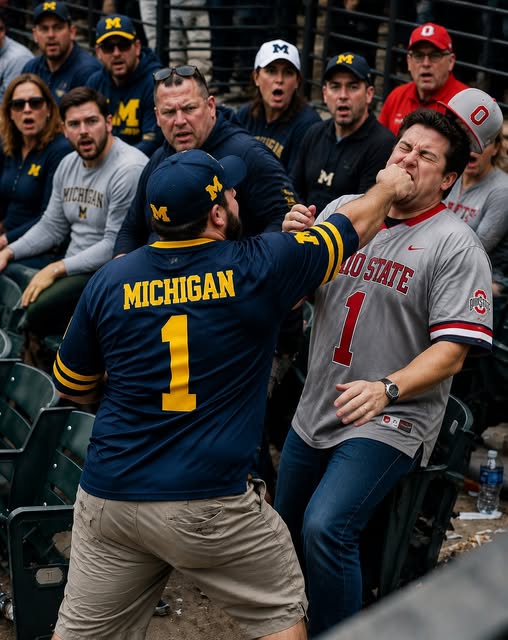
The footage, which has not been independently verified in full detail, shows tension boiling over between spectators dressed in Michigan and Ohio State colors, two programs whose rivalry is among the most intense in American collegiate sports. In the clip, a confrontation erupts in the seating area before at least one individual is seen striking another, triggering a wider physical exchange that draws in multiple bystanders before security personnel and other attendees intervene to separate those involved.
The incident unfolded against the backdrop of a decisive Michigan performance on the field. The Wolverines controlled the game from the opening pitch, applying pressure early and never allowing Ohio State to find rhythm offensively. By the time the final out was recorded, Michigan had secured a comprehensive 9–0 victory, a result that reflected both dominance in pitching and timely execution at the plate.
But the postgame narrative quickly shifted away from the scoreboard.
According to multiple eyewitness accounts shared online, tensions between opposing fan groups had been simmering throughout portions of the game, with verbal exchanges reported in different sections of the stadium. While such rival energy is not uncommon in high-profile matchups between Michigan and Ohio State—two programs separated not just by geography but by decades of competitive history—the situation appeared to escalate rapidly after the final whistle.
In the video, which has since been widely circulated and debated, the altercation appears to begin with a verbal confrontation before physical contact is made. Once the initial blow is thrown, the situation escalates into a brief but chaotic scuffle involving several individuals. The scene unfolds in the stands rather than on the field, underscoring that the confrontation was not between players or coaches, but among spectators.
Security presence is visible in the aftermath of the clash, with individuals attempting to separate those involved as other fans step back from the immediate area. It is not immediately clear how many people were directly involved or whether any injuries were reported in connection with the incident.
As of now, neither Michigan nor Ohio State athletic departments have released formal statements addressing the specific altercation captured in the video. However, both programs routinely emphasize sportsmanship and fan conduct at athletic events, particularly in rivalry matchups that carry heightened emotional stakes.
The Big Ten Conference, which governs both programs, has also not issued an official response regarding potential disciplinary measures or investigations stemming from the incident. Typically, such matters are reviewed in coordination with venue security, host institutions, and local authorities when necessary, especially when physical altercations occur in public event spaces.
What remains clear is that the rivalry between Michigan and Ohio State continues to extend far beyond the field of play. While the two schools are best known for their historic football clashes—often labeled among the most intense rivalries in all of sports—the competitive fire also carries over into other sports, including softball, where postseason implications and conference standings frequently raise the stakes.
Tuesday’s matchup, though not a postseason elimination game, still carried emotional weight for both fan bases. Michigan’s commanding win only amplified the intensity in the stands, as Ohio State supporters endured a difficult outing on the field while Michigan fans celebrated a comprehensive performance from their team.
It is within that emotional imbalance that postgame tensions can sometimes emerge, particularly in environments where opposing fan bases are seated in close proximity. Stadium officials generally attempt to mitigate such risks through security presence and seating design, but rival matchups remain inherently charged.
Sports sociologists have long noted that collegiate rivalries, particularly those with deep historical roots like Michigan–Ohio State, can produce heightened emotional identification among fans. That identification, while often expressed through chants, attire, and competitive banter, can occasionally cross lines when frustration, alcohol consumption, or group dynamics intensify interactions between opposing sides.
In this instance, the viral nature of the video has only amplified attention on the incident. Within hours of circulating on social platforms, the footage sparked widespread commentary, with users debating accountability, security response, and the broader culture surrounding fan behavior at collegiate events.
Some viewers expressed concern over what they described as a growing trend of fan altercations in high-profile sporting environments, while others emphasized that such incidents, though highly visible when recorded, remain relatively rare compared to the overall number of fans who attend games peacefully. Still, the visibility of the altercation has placed renewed scrutiny on event security protocols.
Venues hosting NCAA events typically employ layered security strategies, including uniformed officers, private security personnel, and surveillance systems designed to identify and de-escalate conflicts. However, as this incident illustrates, rapidly developing confrontations in crowded seating areas can still pose challenges for immediate intervention.
The Michigan–Ohio State rivalry itself adds another dimension to the conversation. Few matchups in college athletics generate as much anticipation or emotional investment across multiple sports. That intensity, while a hallmark of the rivalry’s enduring appeal, also increases the likelihood of heightened emotions spilling over in isolated instances.
Michigan’s 9–0 victory in the softball contest further intensified that dynamic. The Wolverines executed a complete performance, shutting down Ohio State’s offense while capitalizing on scoring opportunities to build a commanding lead. By the final innings, the outcome was effectively decided, shifting attention among fans from competition to reaction.
For Ohio State supporters in attendance, the loss represented a difficult outing, and for Michigan fans, the celebration of a dominant win may have contributed to an already emotionally charged environment. In such settings, rival interactions can sometimes escalate beyond verbal exchanges, particularly in tightly packed seating arrangements.
Despite the attention the altercation has received, it is important to note that the vast majority of attendees at collegiate sporting events participate without incident. Universities across the country continue to invest in fan experience and safety measures, recognizing both the importance of spirited rivalry and the need for controlled environments.
Still, moments like the one captured in the viral video serve as reminders of the fine line between passionate support and unacceptable behavior. Athletic departments and conference officials consistently reinforce expectations that fans are responsible for maintaining decorum, regardless of game outcome or rivalry intensity.
As of this report, there is no confirmed information regarding disciplinary actions against those involved in the altercation, nor has there been confirmation of any arrests or formal charges. Investigations, if underway, are typically handled in coordination with venue authorities and local law enforcement.
The broader conversation now extends beyond the incident itself to the culture of modern sports fandom, where social media amplifies moments of conflict in ways that were far less visible in previous decades. A single recording can circulate globally within minutes, shaping perception of an event far beyond its immediate context.
For Michigan and Ohio State, two programs whose rivalry defines much of the Big Ten’s identity, the incident will likely be viewed as an unfortunate footnote to an otherwise one-sided softball result. Yet the visibility of the altercation ensures it will remain part of the postgame narrative long after the final score fades from memory.
In the immediate aftermath, attention will likely turn to whether further details emerge regarding the individuals involved and whether institutions take additional steps to reinforce fan conduct policies at future matchups. Both universities have historically emphasized respect and sportsmanship, values that stand in contrast to the behavior seen in the viral footage.
For now, the image that lingers is not Michigan’s dominant 9–0 victory on the field, but the chaotic moment that followed it in the stands—a reminder that even in collegiate sports, where tradition and pride run deep, emotions can sometimes spill over in ways that challenge the boundaries of the game itself.