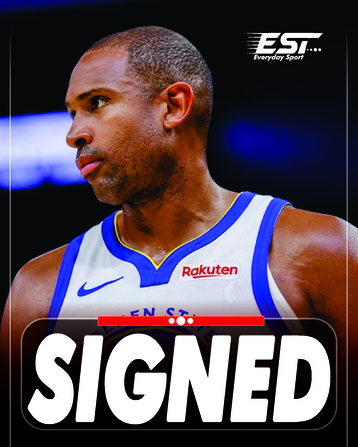
Veteran Al Horford declines player option, agrees to two-year, $14 million deal to stay with Golden State Warriors, eyeing historic 20th NBA season.
OAKLAND, Calif. — In an NBA landscape increasingly dominated by flash, youth, and superteam volatility, Al Horford remains a quiet constant. The 40-year-old big man, who has seen nearly every iteration of the modern game since entering the league as the No. 3 overall pick in 2007, is set to decline his player option with the Golden State Warriors and re-sign on a new two-year, $14 million contract, according to Shams Charania and Anthony Slater. The deal, which keeps the veteran anchored in the Bay Area, positions Horford to become just the 13th player in NBA history to suit up for a 20th season — a testament to durability, adaptability, and an unwavering commitment to craft over flash.
For Horford, whose basketball journey began in the Dominican Republic before flourishing at the University of Florida under Billy Donovan, this decision represents more than just another paycheck. It is a deliberate choice to extend a career built on versatility, defense, and team-first basketball at a time when many of his contemporaries have long since hung up their sneakers. At an age when most centers are either retired or relegated to cameo roles, Horford continues to contribute meaningfully, logging significant minutes in Golden State’s 2025-26 campaign while providing the kind of steadying presence that Steve Kerr’s system has always prized.
Those close to the situation describe the negotiations as smooth, reflective of the mutual respect that has developed between Horford and the Warriors organization since he first joined the franchise. The two-year structure offers Golden State flexibility while giving Horford the security to chase one more deep postseason run alongside Stephen Curry, Draymond Green, and a revamped supporting cast that includes Jimmy Butler and a mix of young talent like Brandin Podziemski and Moses Moody. At $7 million per year on average, the deal is team-friendly for a contender still navigating the twilight of its dynasty era while trying to build sustainably around its aging core.
Horford’s path to this moment has been anything but linear. Drafted by the Atlanta Hawks, he quickly established himself as one of the league’s most reliable two-way bigs, earning All-Star nods in 2010 and 2011 and anchoring some gritty Eastern Conference teams. Stints with the Boston Celtics — where he won an NBA championship in 2024 — the Philadelphia 76ers, and a brief detour with Oklahoma City showcased his evolution from traditional post presence to a stretch-big who could space the floor, facilitate, and protect the rim at a high level even as Father Time crept in.
His numbers this past season with Golden State — 8.3 points, 4.9 rebounds, and 2.6 assists per game across 45 appearances — don’t jump off the page, but they belie his true value. Horford’s basketball IQ remains elite. He spaces the floor at a respectable 36.1 percent from three, makes smart reads in the pick-and-roll, and provides veteran leadership in a locker room that still leans on Curry’s gravity and Green’s intensity. Defensively, his timing and positioning help mask some of the athletic decline that comes with turning 40 in June. Opponents still respect his ability to alter shots and rotate help-side with precision.
For the Warriors, retaining Horford is about continuity in a season that ended with a 37-45 record and a 10th-place finish in the Western Conference. The franchise is in a delicate transition phase. Curry, now 38, continues to defy age with his otherworldly shooting, but the supporting pieces around him require careful management. Adding Horford initially last offseason provided a bridge between the veteran core and younger pieces like Podziemski and Gui Santos. His willingness to accept a reduced role and mentor the next wave has been invaluable, according to sources within the organization.
“Al is the ultimate pro,” one Warriors assistant coach said on condition of anonymity. “He shows up every day ready to work, doesn’t complain about minutes, and his voice carries weight because he’s been through it all. Having him back stabilizes everything from our second-unit rotations to how we prepare for playoff-style basketball.”
This re-signing also carries symbolic weight for Golden State. The Warriors have long prided themselves on culture — the “Strength in Numbers” ethos that fueled their dynasty. Horford embodies that. He isn’t chasing individual accolades anymore; at this stage, it’s about rings, respect, and leaving the game better than he found it. His 2024 title with Boston proved he could still contribute to a champion, and his move west was seen by many as a chance to chase another with Curry before the window closes.
Reaching 20 seasons would place Horford in rare company. The list of players who have accomplished the feat includes legends like LeBron James (now in his 23rd), Vince Carter (22), Robert Parish, Kevin Garnett, Dirk Nowitzki, and Kobe Bryant. Most of those names are either Hall of Famers or locks for Springfield. Horford may not have the MVP hardware or scoring titles, but his consistency across nearly two decades speaks volumes. He ranks among the elite in career versatility metrics, boasting impressive totals in points, rebounds, assists, and blocks while maintaining one of the cleanest injury histories for a big man of his size and mileage.
What makes Horford’s longevity even more remarkable is the physical toll the position demands. Centers and power forwards absorb nightly punishment — screens, post-ups, and the relentless pace of today’s spacing-oriented game. Yet Horford has adapted repeatedly: adding a reliable three-point shot later in his career, refining his footwork, and prioritizing recovery and film study. Those who have covered him over the years note his meticulous preparation, from nutrition to mobility work, as key factors in defying expectations.
Teammates past and present rave about his impact off the court. Jayson Tatum and Jaylen Brown credited Horford’s leadership during Boston’s championship run. In Golden State, younger players like Podziemski have spoken about learning defensive positioning and screen navigation from the veteran. “He’s seen every defense, every offensive scheme,” Podziemski said earlier in the season. “Just being around him elevates your game.”
Financially, the $14 million commitment is prudent for Golden State, especially with Curry’s massive extension still on the books and other veterans like Green and Butler commanding significant cap space. It allows the front office, led by Mike Dunleavy Jr., room to maneuver in future offseasons while addressing depth and wing scoring. The second year includes options that could provide an exit ramp if Horford’s production dips sharply or if the team pivots toward a full youth movement.
Of course, no discussion of Horford’s future is complete without acknowledging the physical realities. At 40, even the most durable athletes face limitations. His minutes will likely be managed carefully, with increased reliance on matchups and load management. But Kerr has proven adept at deploying veterans effectively, as seen with past contributions from Andre Iguodala and others. Horford’s ability to play both center and power forward gives the coaching staff schematic flexibility, particularly in small-ball lineups that have defined the Warriors’ identity.
Looking ahead, this contract could set the stage for a meaningful 2026-27 season. If Golden State can supplement its roster with the right mix of shooting and defense, Horford could play a pivotal role in a potential playoff push. His experience in high-stakes environments — multiple Eastern Conference Finals appearances and that 2024 title — is invaluable for a group still searching for its next championship DNA.
Beyond basketball, Horford’s story resonates on a human level. A family man with deep roots in the Dominican Republic and the United States, he has used his platform for community work, including basketball development programs in Latin America. His career serves as a blueprint for longevity: skill over athleticism, intelligence over flash, and professionalism above all.
As the NBA offseason heats up with free agency and trade rumors swirling, Horford’s decision brings a moment of stability for the Warriors. In a league where player movement often dominates headlines, his choice to stay speaks to loyalty, fit, and the pursuit of something greater than individual stats. For a player who has quietly compiled over 15,000 career points, nearly 9,000 rebounds, and thousands of assists while adapting to five different franchises, this extension is another chapter in a remarkable legacy.
Warriors fans, long accustomed to stars like Curry carrying the torch, now have another veteran to root for as he chases history. Whether it ends with another title or simply with Horford etching his name among the game’s most enduring figures, one thing is certain: Big Al isn’t done yet. At 40, with 20 seasons on the horizon, Al Horford continues to prove that basketball excellence isn’t reserved for the young and explosive — sometimes, it’s the steady hand guiding the ship that makes the difference.
The deal is expected to be signed in the coming days once the player option is formally declined, with Horford expressing excitement about continuing his Bay Area chapter. For Golden State, it’s a vote of confidence in the culture Kerr and Curry have built. For Horford, it’s one more opportunity to do what he does best: compete, contribute, and chase greatness on his own terms. In a sport that celebrates the spectacular, his story reminds us of the beauty in the enduring.