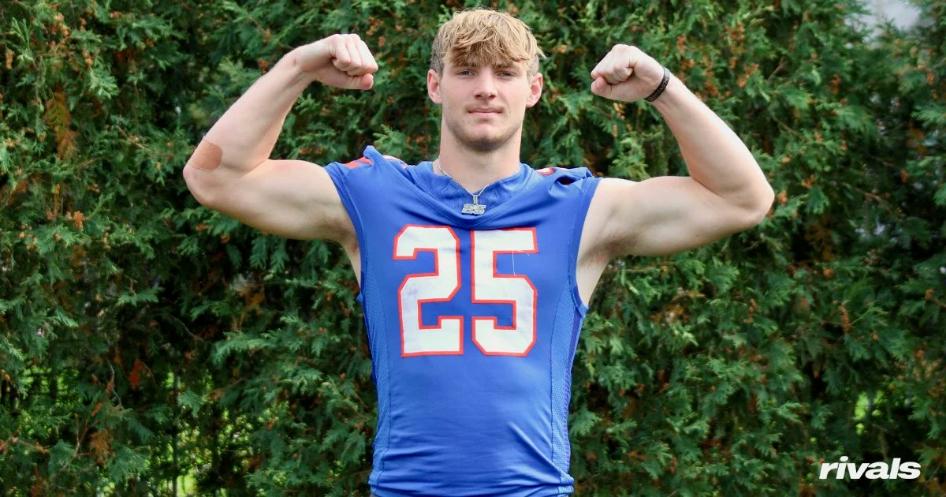
The recruitment of one of the nation’s most productive young running backs is about to shift from summer conversations to one of college football’s most important proving grounds: Saturdays in the fall.
Xander Edwards, the four-star 2028 running back from The Bolles School in Jacksonville, Florida, has mapped out an ambitious schedule of 12 fall visits, setting the stage for a recruiting race that already stretches across the SEC, Big Ten, ACC and Notre Dame. And while there remains substantial time before Edwards reaches a decision, the early picture is beginning to take shape.
According to recruiting intel from Rivals, a select group of programs has established an early advantage in the pursuit of Edwards, one of the most coveted backs in the 2028 cycle. The fall itinerary, however, ensures that the race is far from settled.
For Edwards, the upcoming visits will offer something recruiting phone calls and summer camps cannot replicate: a firsthand look at how programs operate when the stadium is full, the stakes are real and every snap carries consequences for conference championships and College Football Playoff positioning.
That matters for a prospect whose recruitment has accelerated rapidly.
Edwards has emerged as one of the premier offensive weapons in his class after a dominant sophomore season at Bolles. He rushed for 2,629 yards on 265 carries and scored 44 touchdowns, an average of 9.9 yards per attempt, while adding 17 receptions for 211 yards. The production helped Bolles finish 14-2 and reach the Florida Class 2A championship game.
The numbers are extraordinary on their own. More revealing, however, is the combination of workload and efficiency. Edwards handled 265 rushing attempts and still produced nearly 10 yards per carry, a rate that reflects more than raw breakaway speed. His tape shows a runner capable of pressing the line of scrimmage, manipulating second-level defenders and accelerating through creases once his offensive line creates a defined lane.
At approximately 6-foot-1 and more than 210 pounds, depending on the listing, Edwards has the physical profile of a back capable of handling contact between the tackles while possessing enough burst to create explosive plays in space. That combination has made him an attractive target for programs with dramatically different offensive identities.
Miami, Florida, Georgia, Indiana, Wisconsin, Ohio State, Michigan, Florida State and Notre Dame are among the major programs that have emerged in Edwards’ recruitment, while his offer sheet has continued to expand nationally. Ohio State extended an offer in June following a strong showing during the Buckeyes’ summer camp circuit, and Notre Dame followed with an offer that added another significant layer to his recruitment.
The Miami connection is particularly notable.
Edwards has spoken publicly about the strength of his relationship with the Hurricanes’ coaching staff, identifying Miami among the programs recruiting him most aggressively. He previously said the Hurricanes were “definitely up there” because of his relationships with the coaches and the staff’s message that he is a priority in the class.
Miami has also generated favorable recruiting momentum elsewhere in the industry. A July report noted that 247Sports insider Zach Blostein had entered an early Crystal Ball prediction for Edwards to eventually land with the Hurricanes, though such predictions are projections rather than commitments and the recruitment remains open.
That distinction will be important throughout the fall.
Edwards is still more than a year away from the traditional signing phase of the 2028 cycle. At this stage, relationships can change, coaching staffs can turn over, offensive coordinators can leave and depth charts can look entirely different. The programs that currently hold the strongest positions must still prove that their vision for Edwards matches the direction of their offenses.
That is precisely why gameday visits can be so influential.
For a running back, the evaluation goes beyond watching a stadium atmosphere. Edwards will be able to study offensive structure in real time: how frequently a team operates from shotgun versus under center, how often it uses gap schemes compared with zone concepts, whether the back is involved in the passing game and how much autonomy the position receives in protection adjustments.
The best programs also understand that elite backs are increasingly evaluating development alongside immediate opportunity.
The modern recruiting pitch at the position has become more complicated because of the NFL’s evolving economics. The league has repeatedly demonstrated that running backs can be productive and essential without necessarily receiving the same long-term financial security afforded to quarterbacks, offensive tackles or premier pass rushers. As a result, college development has become a central part of the calculation for prospects who envision an eventual NFL future.
There are no NFL salary-cap implications attached directly to Edwards’ college decision, of course, and any suggestion otherwise would misunderstand the recruiting process. But his recruitment does intersect with the broader professional landscape. College programs selling NFL development must show not only that they can produce rushing statistics, but also that they can prepare backs for a league increasingly demanding versatility.
That means pass protection, route running, ball security and processing are nearly as important as a player’s highlight-reel runs.
Edwards’ receiving production — 17 catches for 211 yards during his breakout season — offers an early indication that he can contribute beyond conventional first- and second-down responsibilities.
The Big Ten schools involved can offer different versions of that development model.
Ohio State remains one of college football’s most powerful recruiting brands and has historically possessed the infrastructure to attract elite skill-position talent from outside its geographic footprint. Michigan can point to its long-standing emphasis on the running game and physical offensive football. Indiana and Wisconsin, meanwhile, represent programs where offensive identity and running-back usage could become central elements of their pitches.
Edwards has specifically identified Miami, Florida, Wisconsin, Indiana, Georgia and Ohio State among the schools pursuing him aggressively, underscoring how broad the competition has become.
Georgia presents another powerful factor in the equation: championship-level recruiting, SEC competition and a roster-building model that has consistently attracted elite athletes at nearly every position. Florida, meanwhile, has the obvious geographic advantage of keeping an elite Jacksonville prospect in-state.
Then there is Notre Dame, where the recruitment carries a family connection.
Edwards is the son of former Notre Dame standout Marc Edwards, who played for the Fighting Irish from 1993 through 1996 before embarking on a nine-year NFL career that included a Super Bowl championship with the New England Patriots. Marc Edwards rushed for 1,591 yards and 27 touchdowns during his Notre Dame career, creating an undeniable historical link between the Edwards family and South Bend.
But the legacy connection does not guarantee anything.
In modern recruiting, family history can open a door, but it rarely closes a recruitment. Edwards is being evaluated as one of the best backs in the 2028 class, and his eventual decision will likely involve a complicated balance of relationships, offensive fit, development, academics, NIL opportunities and long-term professional preparation.
The fall schedule should provide important answers.
Each visit gives a school another opportunity to move beyond recruiting presentations and demonstrate its football identity. A team that promises to feature the running game can show exactly how it performs against high-level competition. A program selling a path to early playing time can provide context through its current depth chart. A staff emphasizing NFL development can point to the responsibilities its backs handle on Saturdays.
The recruiting landscape has also changed dramatically since Marc Edwards’ era at Notre Dame.
The transfer portal has transformed roster management. NIL opportunities have added another layer to player decision-making. Expanded College Football Playoff access has created additional avenues for programs outside the traditional handful of national powers to sell championship opportunity.
That means Edwards’ recruitment is not simply a battle between blue-blood brands.
Programs such as Indiana and Wisconsin can make legitimate football cases based on scheme, opportunity and relationships. Miami can sell the advantage of remaining in his home state while competing in a talent-rich environment. Georgia can offer the SEC’s annual championship pressure. Ohio State and Michigan can leverage the Big Ten’s national profile and recruiting infrastructure. Notre Dame can combine a family connection with its independent national platform.
For now, Rivals’ belief that a handful of programs have created early separation should be viewed as a snapshot rather than a finish line.
The next several months will test those positions.
Edwards’ 12-visit fall schedule gives him an unusually broad opportunity to compare programs during the season rather than relying exclusively on offseason tours, camps and recruiting pitches. That could help clarify which staffs have built the deepest relationships — and which programs simply made an early impression.
There is also the matter of performance.
Recruiting momentum often follows what happens on the field. A coaching staff that enters the season with playoff expectations and finishes outside the conference race may have a different recruiting message by December. Conversely, a program that exceeds expectations can suddenly gain credibility with prospects who watched its culture and development firsthand.
For Edwards, the process is still in its early stages. He has not narrowed his recruitment to a final group, and there is no credible basis to treat any program as a lock.
But the fall represents a significant next step.
The phone calls, offers and summer evaluations helped make Xander Edwards one of the most sought-after running backs in the 2028 class. Now comes the portion of recruiting that can change everything.
Twelve visits. A crowded field of national powers. Several programs with early momentum.
And for the schools chasing the Jacksonville star, every Saturday on Edwards’ calendar is an opportunity to prove that an early edge can become something far more meaningful.