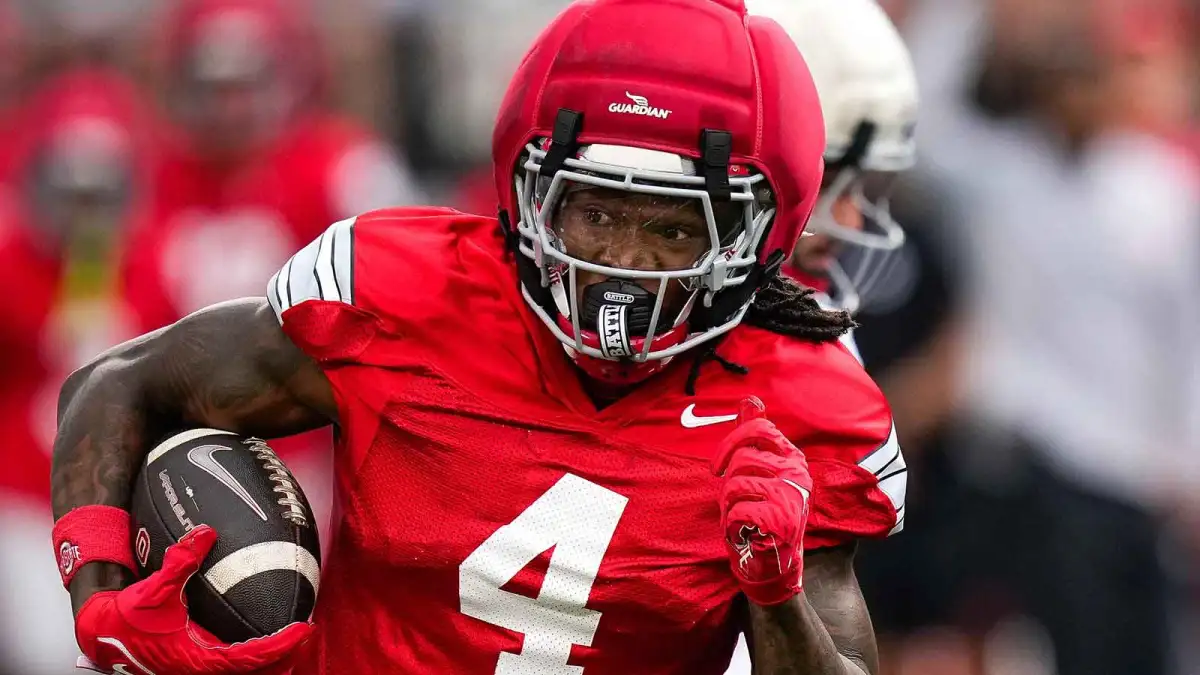
The early evaluations coming out of Columbus rarely carry restraint when it comes to elite wide receiver prospects, but even by Ohio State standards, the praise surrounding Jeremiah Smith has begun to sound like something reserved for generational talents rather than typical five-star freshmen. The latest comparison from a leading football expert has pushed that conversation into even rarer air, with Smith being measured against two of the most dominant wide receivers of the modern NFL era—Julio Jones and Andre Johnson—a pairing that immediately signals both physical dominance and long-term projection at the highest level of the sport.
For Ohio State, a program long defined by its ability to produce NFL-caliber wide receivers, the emergence of Smith as a headline name is not unexpected. What is unusual is the speed and intensity with which analysts are beginning to frame his ceiling. The Buckeyes have seen stars come through their system at receiver with regularity—players like Marvin Harrison Jr., Garrett Wilson, Chris Olave, and others who went on to become first-round picks—but Smith’s trajectory is already being discussed in terms that suggest he could belong in an even more exclusive tier if his development continues at its current pace.
The comparison to Jones and Johnson is not made lightly. Both former NFL receivers defined eras of physical dominance at the position. Jones, at his peak with the Atlanta Falcons, was a rare blend of size, speed, and body control, consistently overwhelming defensive backs even when they knew exactly where the ball was going. Johnson, during his prime years with the Houston Texans, was a technician with elite strength at the catch point and an uncanny ability to win contested situations, often turning tightly covered passes into routine gains. To place Smith in that conversation is to suggest not just collegiate excellence, but prototype-level NFL projection.
What stands out most about Smith, according to scouts and analysts tracking his progression, is how naturally his physical profile translates to dominance on the field. At the high school level, he was already operating as a mismatch problem from the moment he stepped onto the field. His frame, length, and coordination allowed him to separate from defenders without needing to rely purely on speed, while his ball skills made contested catches look routine. That combination is precisely what has drawn early comparisons to receivers who have historically been impossible to defend when fully developed.
At Ohio State, the expectation was never that Smith would need a long adjustment period. The Buckeyes recruit wide receivers with the understanding that they are preparing for NFL roles almost immediately. Still, even within that environment, Smith has managed to separate himself through his maturity and physical readiness. Coaches have reportedly been impressed with how quickly he has adapted to the speed of college defenses and how seamlessly he has absorbed the playbook, particularly in concepts that demand precise timing and spatial awareness.
What makes the Jones and Johnson comparisons particularly compelling is that both NFL stars were not just productive receivers but foundational offensive pillars. Jones was the centerpiece of Atlanta’s passing attack for years, capable of stretching defenses vertically and horizontally. Johnson, similarly, was the focal point of Houston’s offense, often drawing double coverage yet still producing elite numbers through sheer technical superiority and physical strength. To invoke those names in relation to Smith is to project him as a future centerpiece, not just a complementary weapon.
Ohio State’s recent history adds weight to the conversation. The program has arguably become the premier wide receiver pipeline in college football, producing elite talent at a consistent rate unmatched nationally. Yet even in that context, Smith’s arrival has generated a different level of anticipation. There is a growing sense among observers that he possesses traits that are not merely refined versions of past Buckeye receivers, but rather a unique blend that could elevate him beyond them in long-term projection.
The physical tools are the first thing that stand out. Smith possesses rare length for a receiver who also demonstrates fluidity in and out of breaks. That combination is often what separates good receivers from great ones, as it allows quarterbacks to trust that a catch radius extends beyond tight coverage windows. It also creates constant leverage advantages against defensive backs, who are often forced to play conservatively against receivers who can win both over the top and through contact.
Beyond the physical traits, what has impressed evaluators is Smith’s composure. Young receivers with his level of hype often struggle with consistency, particularly when transitioning into a system as complex as Ohio State’s offense. However, reports from within the program suggest that Smith has approached the mental side of the game with unusual seriousness. His ability to process defensive looks, adjust routes on the fly, and maintain discipline within structured concepts has been highlighted as one of his most advanced traits.
It is this combination—physical dominance paired with mental maturity—that has fueled the early NFL-style comparisons. Julio Jones, during his time at Alabama and early in his NFL career, was praised for his rare ability to blend athletic explosiveness with precise route execution. Andre Johnson, meanwhile, built his career on technical excellence and reliability in contested situations. Smith’s projection, in the eyes of some analysts, appears to sit at the intersection of those two skill sets.
The broader context of Ohio State’s offensive system also plays a role in shaping expectations. The Buckeyes consistently operate one of the most receiver-friendly schemes in college football, emphasizing spacing, tempo, and vertical threats that allow elite wideouts to showcase their strengths. For a player like Smith, this environment provides both opportunity and scrutiny. Every practice rep is evaluated through the lens of whether he is meeting the standard set by previous stars who have gone on to dominate at the next level.
At the same time, the program’s success creates pressure. When a player is compared to NFL legends before even completing a full college season, the expectations can quickly escalate beyond typical developmental timelines. Coaches and analysts alike are aware of this dynamic, but in Smith’s case, the early returns have done little to temper the excitement. If anything, they have reinforced it.
Opposing defenses will also inevitably begin to adjust. Once a receiver earns a reputation for dominance, defensive game plans often shift to account for his presence. This is where the true test of Smith’s trajectory will begin. The ability to maintain production when facing double coverage, bracket schemes, and physical press coverage is what separates college stars from NFL-bound elites. Jones and Johnson both experienced this early in their careers and responded by refining their technique and expanding their route versatility.
For Smith, the developmental path is still unfolding, but the foundation is clearly being laid for a high-impact role. His ability to win vertically gives Ohio State a dangerous downfield threat, while his strength at the catch point allows quarterbacks to trust him in tight windows. As the season progresses, his usage is expected to expand, particularly in high-leverage situations where contested catches become more frequent.
What cannot be overlooked is the historical context of comparisons of this nature. College football has seen countless highly touted receivers, but only a select few have carried pre-draft or early-career comparisons to players of Jones and Johnson’s caliber and actually fulfilled them. The margin between potential and production at that level is often defined by incremental improvements—release consistency, route detail, conditioning, and durability over a full season.
Still, the fact that such comparisons are being made at this stage speaks to the level of belief surrounding Smith’s ceiling. It suggests that evaluators are not merely projecting him as a future NFL contributor, but rather as a potential star capable of shaping offensive identity at the highest level.
Within Ohio State’s locker room, the focus remains grounded. The program is accustomed to producing high draft picks and managing external expectations. For Smith, the challenge will be maintaining consistency while navigating the attention that comes with such early acclaim. The path from highly touted freshman to NFL comparison is not linear, and every phase of development will be scrutinized more closely given the names already associated with his game.
Yet, for all the caution that typically accompanies such projections, the enthusiasm is difficult to ignore. Players who draw comparisons to Julio Jones and Andre Johnson are not common at any level of football. They represent a standard of excellence defined by dominance, reliability, and game-changing ability. That Smith is even being mentioned in that context underscores how quickly he has captured attention within the sport.
As Ohio State continues its season and Smith’s role inevitably expands, the football world will be watching closely to see whether the early evaluations hold steady or evolve further. If his trajectory continues upward, the conversation will likely shift from comparisons to legacy projection, a space reserved only for those who redefine expectations entirely.
For now, Jeremiah Smith remains one of the most closely watched young receivers in college football, carrying with him not just the weight of Ohio State’s storied receiver tradition, but also the early echoes of two of the NFL’s most physically dominant pass catchers.