In the increasingly intertwined world of college football recruiting, few storylines generate as much intrigue as those involving legacy families, former coaching relationships, and the ever-shifting alliances within the Big Ten Conference. That backdrop has now set the stage for a unique recruiting battle that is beginning to draw attention across the Midwest and beyond: a former Ohio State Buckeyes assistant coach, now on staff at a Big Ten rival, is making a serious push to land the son of Ohio State head coach Ryan Day as part of his program’s future recruiting class.
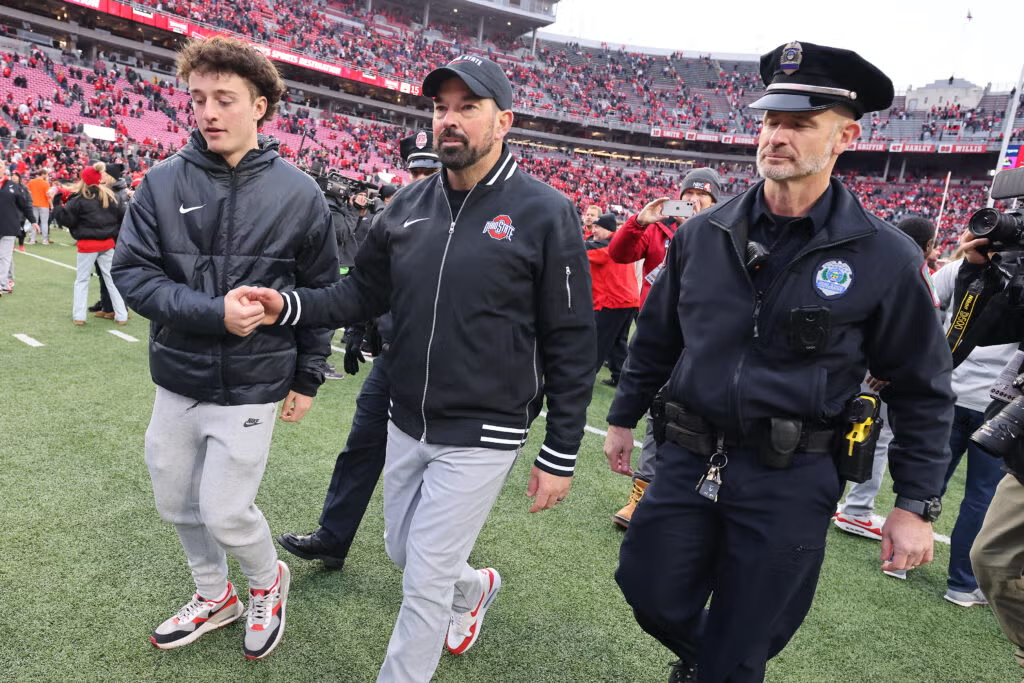
The prospect at the center of the attention is RJ Day, the quarterback son of Ohio State head coach Ryan Day, who has quietly emerged as one of the more closely monitored young signal-caller prospects in his cycle. While RJ Day has not yet publicly narrowed his recruitment, his name alone carries significant weight in recruiting circles given his father’s stature and offensive background with the Buckeyes. That context has only intensified the storyline as a former Ohio State assistant, now working within the expanded Big Ten landscape, attempts to position his current program as a legitimate contender.
Sources familiar with the recruitment landscape describe the situation as both competitive and delicate, given the personal history involved. The coach in question, who spent multiple seasons on Ryan Day’s staff at Ohio State before departing for a higher-profile role in the Big Ten, has maintained professional ties within Columbus while simultaneously carving out a recruiting identity at his new program. Now, that overlap is being tested in real time as he pursues one of the most recognizable quarterback prospects in his region.
The recruitment carries a natural layer of complexity. Ryan Day, who has led the Ohio State Buckeyes through multiple College Football Playoff runs and Big Ten Championship appearances, has built his reputation on quarterback development. Under his leadership, Ohio State has consistently produced NFL-caliber passers and maintained one of the most efficient offenses in college football. That pedigree makes any recruitment involving his son particularly notable, not just for competitive reasons but also for symbolic ones within the sport.
The former assistant coach, now operating within the infrastructure of a Big Ten program that has aggressively invested in recruiting and player development since conference expansion, is believed to have taken a direct but respectful approach. Rather than attempting to leverage personal ties in an overtly aggressive manner, the pitch has centered on offensive fit, long-term development, and the opportunity to carve an independent path outside the shadow of his father’s program.
Still, the optics are unavoidable. Recruiting the son of a former head coach and current powerhouse program leader adds an emotional dimension that few situations in college football can replicate. The relationship between Ryan Day and his former assistant has reportedly remained cordial, though both programs are now positioned as potential competitors for the same quarterback talent.
Within Ohio State circles, there is an awareness of the situation, though it has not been treated as a disruption. The Buckeyes continue to evaluate quarterback talent across multiple recruiting classes, maintaining their traditional approach of casting a wide net at the position. Internally, there is recognition that RJ Day’s recruitment will naturally draw attention, but it is being handled with the same measured approach Ohio State applies to all top-tier prospects.
The Big Ten Conference landscape only adds another layer of intrigue. With the addition of programs like USC and UCLA, the recruiting footprint has expanded significantly, bringing West Coast influence and increased national competition into the traditionally Midwest-heavy conference. That shift has allowed programs like USC Trojans to become more aggressive in pursuing nationally recognized prospects, including those with deep ties to established Big Ten powers.
In this case, the former Ohio State assistant’s current program has leaned heavily into that expanded identity. The pitch to recruits has emphasized national exposure, modern offensive schemes, and the ability to compete in a conference that now spans multiple time zones and recruiting hotbeds. For a quarterback prospect like RJ Day, those factors are particularly relevant, especially given the evolving nature of college football offenses and the increasing importance of adaptability at the position.
The coach’s familiarity with the Ohio State system is also viewed internally as both an advantage and a point of sensitivity. Having worked closely with Ryan Day’s offensive structure, he understands the developmental blueprint that has made the Buckeyes one of the most quarterback-friendly programs in the country. That knowledge allows for a nuanced recruiting approach, one that can both acknowledge Ohio State’s strengths while presenting an alternative vision for player development.
Recruiting analysts have noted that while Ohio State remains a strong contender for virtually any in-state quarterback prospect, the presence of a former staff member actively recruiting against them introduces an unusual dynamic. It is not uncommon for assistant coaches to move within the Big Ten and pursue familiar recruiting territories, but targeting the son of a former head coach adds a rare personal dimension to the competition.
For Ryan Day, the situation is understood to be handled with professional distance. As one of the most prominent figures in college football coaching, he is accustomed to navigating high-stakes recruiting battles, media scrutiny, and internal staff turnover. However, the involvement of a former assistant in his son’s recruitment is an uncommon wrinkle that underscores the increasingly interconnected nature of the sport.
Those close to the Ohio State program describe Day as maintaining a clear boundary between his professional responsibilities and personal matters. The Buckeyes’ recruiting strategy continues to operate independently of familial considerations, focusing instead on long-term roster construction and quarterback depth across multiple cycles.
Meanwhile, the former assistant’s current program has continued to gain traction in national recruiting conversations. Since joining his new Big Ten home, he has been credited with strengthening the program’s quarterback pipeline and expanding its reach into talent-rich regions. His pursuit of RJ Day is viewed internally as part of a broader effort to elevate the program’s recruiting profile and signal its willingness to compete with traditional Big Ten powers on high-level prospects.
There is also an undeniable narrative component that has fueled outside interest. The idea of a coach attempting to recruit the son of his former boss creates a storyline that resonates beyond recruiting circles. It speaks to the evolving nature of loyalty, opportunity, and competition in modern college football, where staff mobility is constant and recruiting relationships are often tested by career progression.
For RJ Day, the process remains ongoing and largely private. As with many high-profile quarterback prospects, his recruitment is expected to be methodical, with attention paid to coaching stability, offensive systems, and long-term development opportunities. While his last name ensures added attention, those familiar with his evaluation process emphasize that his recruitment will ultimately be decided on the same criteria as any other elite quarterback prospect.
Still, the presence of a former Ohio State coach actively recruiting him within the Big Ten adds an undeniable layer of intrigue. It ensures that his recruitment will be followed closely not only by fans of the Buckeyes, but by observers across the conference who understand the symbolic weight of such a pursuit.
As the recruiting cycle progresses, both programs are expected to remain in communication with the quarterback prospect and his representatives. Official visits, evaluations, and continued development will ultimately shape the trajectory of his decision. For now, the storyline serves as a reminder of how interconnected college football has become, where professional paths cross personal histories and recruiting battles often extend beyond the field into the fabric of coaching relationships.
What began as a standard quarterback recruitment has evolved into a high-interest Big Ten subplot, driven by history, familiarity, and competitive ambition. And while no final decision has been made, the presence of a former Ohio State coach attempting to land Ryan Day’s son ensures that this particular recruitment will remain one of the more closely watched developments in the cycle.