Baylor’s Hosea Wheeler receives temporary injunction, eligible for Week 1
Baylor’s defensive line finally has the answer it has been waiting for.
Sixth-year defensive tackle Hosea Wheeler has been granted a temporary injunction that allows him to play for the Bears during the 2026 season, clearing the way for the Indiana transfer to suit up in Baylor’s season opener against Auburn on Sept. 5, according to recent reports. The ruling provides an immediate boost to a Baylor defense that made strengthening the line of scrimmage one of its central priorities this offseason.
The decision also adds another chapter to the increasingly complicated eligibility landscape surrounding college football, where courtrooms have become an increasingly important part of roster construction.
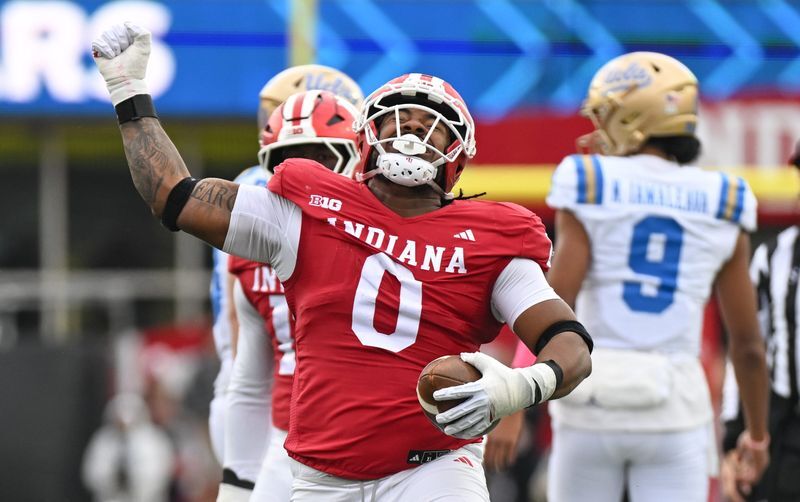
Wheeler’s eligibility had been in doubt because he had already accumulated four seasons of college football, including three at Western Kentucky after beginning his career at Sacramento City College. He transferred to Indiana for the 2025 season and played all 15 games for the Hoosiers as they completed a 15-0 season and won the national championship. Baylor subsequently brought him to Waco, but the NCAA did not grant him the additional season he sought.
Rather than wait for the NCAA process to resolve itself, Wheeler pursued legal relief.
He initially was involved in the federal antitrust litigation surrounding NCAA eligibility rules but voluntarily dismissed that case in late June, choosing instead to pursue a temporary injunction through a state court. Baylor coach Dave Aranda acknowledged during Big 12 media availability that the program was working aggressively to find a resolution for Wheeler and offensive lineman Yakiri Walker, who also faced an eligibility dispute.
“We’re fighting hard to have both,” Aranda said in July, while acknowledging that the situation remained unresolved.
Now, Wheeler has the opportunity to play.
The immediate significance for Baylor is difficult to overstate. At 6-foot-3 and 306 pounds, Wheeler was brought in specifically to provide experience, physicality and disruption in the middle of a defensive front that Baylor believes can become one of the strongest units on the roster.
The Bears spent the offseason rebuilding from the inside out. Aranda said at Big 12 Media Days that the line of scrimmage had become the primary focus of Baylor’s roster investment after the program previously directed much of its available NIL resources toward perimeter skill positions.
“The line of scrimmage is where our attention and our money has gone this year,” Aranda said.
Wheeler sits at the center of that strategy.
His résumé explains why Baylor was willing to make him a priority. He has appeared in 46 career games with 30 starts, recording 139 tackles, four sacks, two forced fumbles and an interception. Before arriving at Baylor, he earned first-team All-Conference USA honors at Western Kentucky in 2024 after recording 65 tackles, two sacks and a forced fumble in 14 starts. He also played a meaningful rotational role on Indiana’s national championship team last season, appearing in all 15 games and making five starts while finishing with 31 tackles, four tackles for loss and two fumble recoveries.
That combination of size and experience gives Baylor something it could not easily manufacture through a younger player.
Interior defensive linemen are often asked to absorb double teams, compress rushing lanes and create favorable one-on-one matchups for edge defenders. Wheeler’s presence should allow Baylor defensive coordinator Joe Klanderman to be more aggressive with fronts and pressure packages without consistently sacrificing run integrity.
That matters because Baylor is attempting to transform a defensive front that struggled to establish itself consistently last season.
The program responded by bringing in multiple experienced defensive linemen, including Wheeler, Jamaal Whyce Jr., Jordan Mack and Kamren Washington. Senior safety Michael Allen said the defensive line became a priority as early as January and praised the additions for giving the Bears a chance to create more negative plays and turnovers.
“We’re going to get vertical, cause havoc — tackles for loss, sacks, turnovers, things like that,” Allen said.
Wheeler’s return to eligibility gives that philosophy its most experienced interior piece.
There is also a larger strategic consequence.
Baylor opens the season against Auburn on Sept. 5 at Mercedes-Benz Stadium in Atlanta in a nationally televised matchup. The game represents one of the most important early tests on the Bears’ schedule, and having Wheeler available from the opening snap changes the defensive calculus for a team attempting to establish itself in the Big 12 and improve its postseason position.
For Aranda, the difference is not simply adding another body to the rotation. It is adding a veteran who has already played championship-caliber football.
Wheeler helped Indiana navigate a perfect 15-0 season, playing against opponents such as Oregon, Penn State, Alabama and Miami. He recorded two tackles against Alabama and another tackle in the national championship game against Miami. His experience in high-leverage situations could become particularly valuable for a Baylor defense integrating a new-look coaching structure under Klanderman.
There is, however, an important caveat.
A temporary injunction is not necessarily a permanent declaration that Wheeler will ultimately be granted another full season of eligibility. Recent reporting indicates that the court has requested a trial date within roughly 90 to 120 days. That means the legal dispute could continue into the season, potentially creating uncertainty later in the year if the injunction is overturned.
For now, though, Baylor can operate as though Wheeler is available.
That distinction is crucial.
College football programs spend months designing depth charts, installing defensive packages and allocating NIL resources around players they believe will be available. Losing an expected starter shortly before the season can force a coaching staff to simplify its rotation or accelerate the development of an inexperienced replacement.
Baylor avoided that immediate problem.
The situation also underscores how dramatically college football’s eligibility rules are being tested. The traditional NCAA framework was built around defined limits on a player’s playing career, but a series of lawsuits and court injunctions has created a growing patchwork of exceptions and temporary remedies.
Wheeler’s case follows a broader trend in which athletes have turned to state and federal courts when NCAA eligibility decisions threaten to end their careers. The legal battles involving players such as Diego Pavia and Trinidad Chambliss have helped reshape the conversation around eligibility, particularly for athletes seeking additional seasons after circumstances outside their control affected their careers.
The implications extend beyond Baylor.
If players can repeatedly secure temporary judicial relief, roster planning could become even more complicated for coaches, conferences and the NCAA. Programs may have to prepare for the possibility that eligibility decisions can change rapidly, sometimes days or weeks before kickoff.
For Baylor, however, the issue is much more immediate.
The Bears have built their defensive identity around the line of scrimmage. They invested heavily in experienced bodies. They identified Wheeler as one of the central pieces of that reconstruction. And after weeks of uncertainty, they finally have permission to put him on the field.
Wheeler now gets the opportunity to finish the college career that seemed to be slipping away.
The Bears get something equally valuable: a proven interior defender, a national champion and a veteran presence in the middle of a revamped defense — available when the season begins.
For Baylor, that is more than a legal victory.
It could be the difference between entering Week 1 with a question mark at defensive tackle and entering it with one of the most experienced players on the roster anchoring the front seven.
And after an offseason defined by uncertainty, that clarity could arrive at precisely the right time.