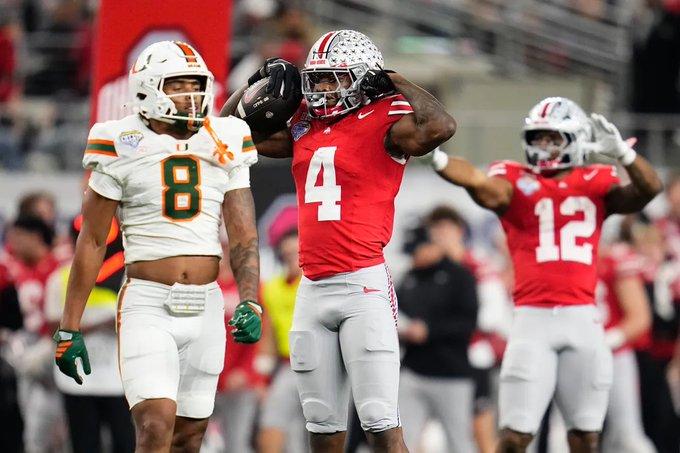
Ohio State Stars Jeremiah Smith and Luke Montgomery Earn Preseason AP All-America Recognition
COLUMBUS, Ohio — Ohio State’s championship ambitions have gained another layer of national validation, with wide receiver Jeremiah Smith and offensive lineman Luke Montgomery earning recognition on the Associated Press preseason All-America teams as the Buckeyes prepare for a season that begins with expectations as high as any program in the country.
The selections reinforce what has become increasingly difficult to dispute entering 2026: Ohio State is loaded with established difference-makers, and Smith remains the centerpiece of an offense expected to carry significant responsibility in the Buckeyes’ pursuit of another College Football Playoff run.
Smith’s inclusion comes as little surprise. After two extraordinary seasons in Columbus, the junior wide receiver has established himself as one of the most productive pass-catchers in the country and one of the most closely watched players in college football.
Through his first two seasons, Smith has accumulated 2,558 receiving yards and 27 touchdown receptions, totals that rank as the most by a Big Ten receiver through his first two collegiate seasons. He is also one of only two Ohio State receivers ever to produce consecutive 1,000-yard seasons.
His 2025 campaign alone produced 87 receptions for 1,243 yards and 12 receiving touchdowns in 13 games, an average of 95.6 receiving yards per game. He also added 21 rushing yards and a touchdown on three carries.
Those numbers only begin to explain Smith’s importance to Ohio State.
Defenses increasingly treated him as the primary problem to solve last season, frequently adjusting coverage before the snap and rotating safeties toward his side of the field. Yet the production remained elite. His combination of size, acceleration, catch-point ability and route versatility allows him to win against press coverage while also creating separation on intermediate and vertical concepts.
The result is a receiver who can alter defensive structure even when the ball is going elsewhere.
That distinction will matter considerably for Ohio State in 2026.
The Buckeyes enter the season ranked No. 1 in the AP preseason Top 25, receiving 40 first-place votes. Oregon sits at No. 2, giving the Big Ten its first 1-2 preseason finish since 1961 and only the second such finish in conference history. The league is also seeking a fourth consecutive College Football Playoff championship after Big Ten programs captured the previous three national titles.
Ohio State’s path, however, will not be straightforward.
The Buckeyes face Texas early, along with conference tests against defending national champion Indiana and Oregon. That schedule puts considerable pressure on the offense to produce consistently against elite opponents, particularly if the College Football Playoff selection process ultimately turns on résumé strength and tiebreakers.
Smith is therefore more than a preseason award candidate. He is one of the players around whom Ohio State’s national championship equation is being built.
Montgomery’s recognition carries a different significance.
Unlike Smith, whose production is visible in box scores, Montgomery’s value is found in the less glamorous portions of the game: protection calls, leverage, hand placement, communication and the ability to maintain a clean pocket while creating movement in the run game.
Montgomery enters the season as one of the central pieces of an offensive line that will be under substantial scrutiny.
He played 870 snaps on offense and special teams last season and was named a second-team All-American by the American Football Coaches Association. He also earned second-team All-Big Ten recognition.
Ohio State’s offensive line is particularly important because of what happened late in the 2025 season.
The Buckeyes possessed enough talent to dominate stretches of the regular season, finishing 12-2, but protection and offensive consistency became issues when the stakes rose. That creates an obvious priority for Ryan Day and his staff entering the new season: build an offensive line capable of sustaining efficiency against the caliber of defensive fronts Ohio State will encounter in November and, potentially, the College Football Playoff.
Montgomery’s development at guard is central to that objective.
He has already accumulated 36 career games and 16 starts, according to Ohio State’s spring-game materials, giving him valuable experience despite still being relatively young by offensive-line standards.
His job will extend beyond simply winning individual blocks. Ohio State’s offense needs its interior linemen to create reliable movement in the run game while preventing interior pressure from collapsing the pocket around quarterback Julian Sayin.
That relationship between Montgomery and Sayin could become one of the defining elements of the Buckeyes’ season.
Sayin enters 2026 after a breakout first season as Ohio State’s starter. He threw for more than 3,600 yards according to the team’s preseason materials and emerged as a Heisman Trophy finalist.
The equation is relatively simple: if Montgomery and the rest of the offensive line can consistently protect Sayin, Ohio State possesses the skill-position talent to punish defenses.
And Smith is the ultimate beneficiary.
The wide receiver’s presence gives Ohio State a schematic advantage because opponents cannot afford to devote every available resource to stopping the run. The Buckeyes can use Smith outside the numbers, in motion, from reduced splits and from formations designed to manufacture favorable matchups.
That versatility becomes even more valuable with an offensive identity expected to emphasize physicality and the running game.
Ohio State’s offseason has also featured significant turnover on defense, increasing the importance of offensive consistency. The Buckeyes return substantial production on offense but considerably less on defense, meaning the offense may have to absorb more of the burden in high-leverage games.
For Smith, the preseason AP recognition also adds to an already enormous list of expectations.
He was a unanimous All-American in 2025 and became the second unanimous All-American wide receiver in Ohio State history after Marvin Harrison Jr.
That comparison is impossible to avoid.
Harrison’s production, polish and eventual NFL draft status established the standard for modern Ohio State receivers. Smith now has a chance to challenge that benchmark, although his immediate objective is more pressing: turn individual dominance into another national championship opportunity.
The financial implications are different from those associated with professional football. College players are not operating under an NFL-style salary-cap system, so there is no traditional cap charge or contract structure to analyze. Instead, Smith’s value exists within the rapidly changing NIL and revenue-sharing landscape, where elite players have become central assets in roster construction and retention.
Montgomery’s situation illustrates the same shift from a different position.
Offensive linemen rarely receive the same public attention as star receivers, but programs competing at the highest level increasingly have to invest heavily in retaining proven players at premium positions. A reliable interior offensive lineman can be just as important to championship roster construction as a high-profile skill player.
The broader message from the AP recognition is therefore significant.
Ohio State is not entering 2026 simply as a talented team. It is entering as a team with multiple players already viewed nationally as among the best at their positions.
Smith represents the explosive ceiling.
Montgomery represents the infrastructure required to reach it.
And with Ohio State sitting atop the preseason national rankings, neither player’s individual recognition will be judged in isolation. The Buckeyes are expected to compete for the Big Ten championship and another playoff appearance, and anything short of that will be measured against the extraordinary standard the program has established.
For Smith, the challenge is maintaining historic production while defenses build their game plans around him.
For Montgomery, it is proving that Ohio State’s offensive line can hold up when the season reaches its most consequential games.
If both succeed, the Buckeyes will have two of the ingredients every championship team requires: a matchup-breaking weapon on the perimeter and a dependable foundation in the trenches.
The preseason honors are recognition.
The real test begins when Ohio State’s No. 1 ranking, its schedule and its championship aspirations collide with the reality of Saturdays in the Big Ten.
That is when Smith and Montgomery will have to prove that the preseason expectations were not merely justified — they were still too conservative.