George, one of the most recognizable running backs of his generation, has built a post-playing career that has taken him from the NFL to college coaching, making any legitimate legal development involving him likely to attract significant attention. But allegations involving paternity and family matters carry serious personal consequences, and reporting them as fact without a court filing, official statement or reliable documentation would go beyond what the available evidence supports.
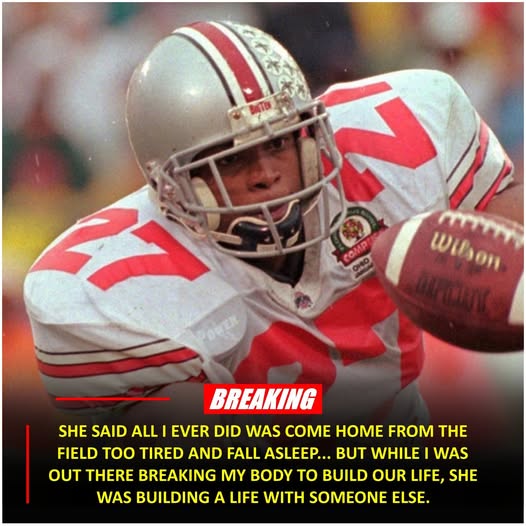
George, 52, remains one of the defining figures in Tennessee football history. After winning the Heisman Trophy at Ohio State in 1995, he became the No. 14 overall selection in the 1996 NFL draft and immediately established himself as one of the league’s most durable workhorse backs.
He spent the majority of his nine-year NFL career with the Houston/Tennessee franchise before finishing his playing career with the Dallas Cowboys. George accumulated 10,441 rushing yards, 68 rushing touchdowns and 268 receptions for 2,227 yards during his NFL career. He was selected to four consecutive Pro Bowls from 1997 through 2000 and earned first-team All-Pro honors in 2000.
His career was built around volume, durability and efficiency in an era when elite NFL offenses frequently relied heavily on featured running backs. George surpassed 1,000 rushing yards in five of his first six seasons and finished his career among the most productive running backs in franchise history.
His importance to Tennessee extended beyond statistics. George became a central figure in the franchise’s rise during the late 1990s and early 2000s, including the team’s run to Super Bowl XXXIV following the 1999 season.
The Titans ultimately retired his No. 27, while Ohio State also retired the number he wore during his college career.
George’s professional life changed considerably after football. He completed his undergraduate degree at Ohio State and later earned an MBA from Northwestern University’s Kellogg School of Management. He subsequently moved into television, business and coaching.
He returned to the football sideline as a head coach at Tennessee State in 2021 and remained there through the 2024 season before taking over at Bowling Green. His transition from NFL running back to college head coach gave him another prominent role in the sport and placed him back under the national spotlight.
That context makes the current allegation particularly sensitive.
At this point, however, there is a significant difference between a claim circulating through social media and a verified legal proceeding. A genuine paternity lawsuit would ordinarily produce a court record identifying the parties, jurisdiction and nature of the action. Without such documentation or confirmation from a credible source, the existence of a lawsuit should not be treated as established fact.
There is also no salary-cap or NFL roster implication connected to the claim. George retired from professional football in 2006 after briefly joining the Cowboys following his release from Tennessee. His current professional responsibilities are in college football, where he is coaching Bowling Green.
Consequently, any attempt to frame the allegation as an NFL personnel story, contract issue or financial development would be misleading.
The broader lesson is one that has become increasingly important in the social-media era. Former athletes and coaches with large public profiles can become the subjects of rapidly spreading claims before journalists, courts or the individuals involved have an opportunity to establish what actually happened.
For a story involving an allegation as personal as paternity, verification must come before publication.
George has previously spoken publicly about his life after football, including the challenges associated with retirement and his transition into a second career. The Tennessee Titans’ documentary coverage of his life has also highlighted his family and post-playing career, including appearances by his wife, Taj George, and their sons.
None of those public records, however, establishes the existence of the alleged lawsuit now being discussed online.
That leaves the central question unresolved: Has a paternity lawsuit actually been filed against Eddie George?
Based on the publicly verifiable information available at the time of publication, there is no confirmed evidence establishing that it has.
If a court filing emerges, or if George, his representatives or an authoritative court record confirms the matter, the story could be reported with the appropriate documentation and context. Until then, the allegation remains exactly that.
For George, whose football résumé is already firmly established, the immediate priority is separating documented fact from an unsupported claim.
And for anyone reporting the story, that distinction is not a technicality. It is the difference between journalism and amplification.