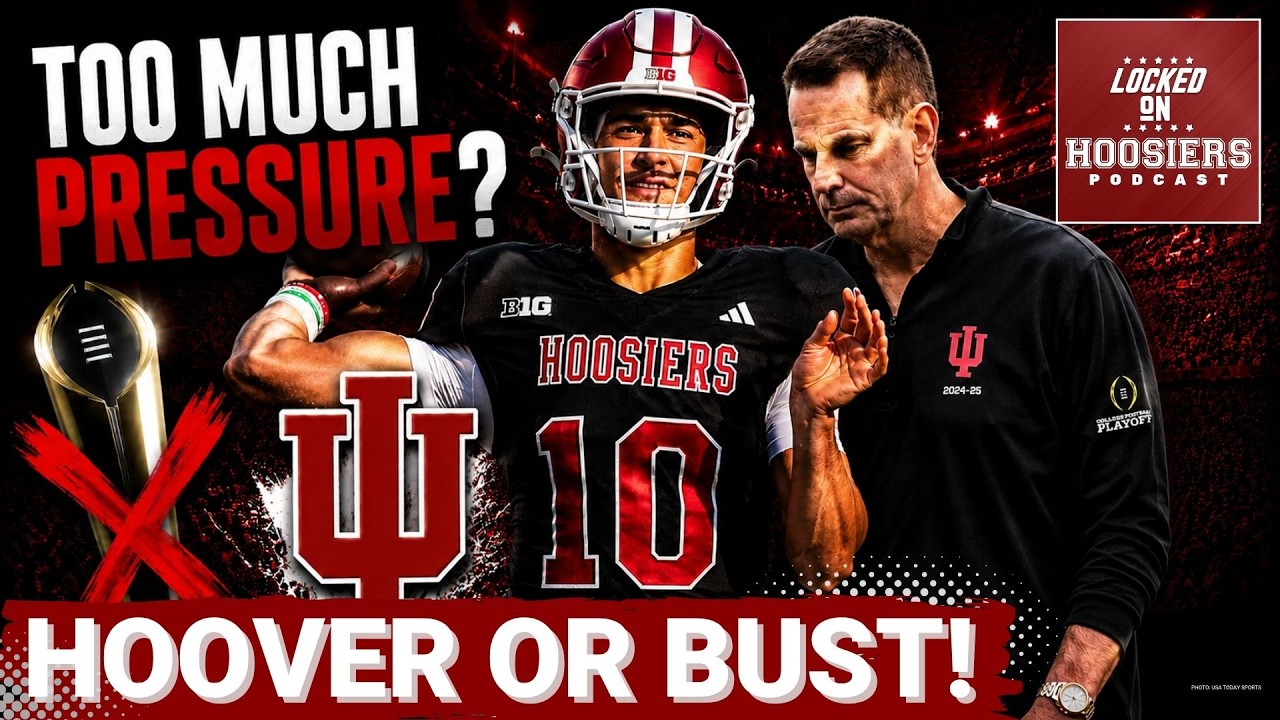
The pressure that comes with following a legend is one of the harshest realities in college football, and right now no quarterback in America may be staring at a heavier burden than Josh Hoover.
At a program that spent decades fighting for national relevance before exploding into the sport’s center stage, Indiana now enters a new era with expectations that would have sounded impossible just a few years ago. The Hoosiers are no longer the underdog story. They are the hunted. They are defending national champions. And according to several prominent college football analysts, the success or collapse of Indiana’s entire 2026 season may rest squarely on the right arm of Hoover.
That reality has quickly become one of the biggest conversations across the college football landscape after an offseason filled with massive roster turnover, sky-high expectations and inevitable comparisons to former Indiana star Fernando Mendoza, whose unforgettable 2025 campaign transformed the program forever. Mendoza led Indiana to a perfect 16-0 season, captured the school’s first national championship and became the first Hoosier ever to win the Heisman Trophy before eventually becoming the No. 1 overall pick in the NFL Draft. (Reuters)
Now Hoover inherits the keys to one of college football’s most fascinating machines.
That transition alone would create enormous scrutiny, but Hoover’s résumé makes the conversation even more compelling. The former TCU quarterback arrives in Bloomington carrying elite production, major-conference experience and statistical credentials that rival nearly every returning quarterback in the nation. Hoover transferred to Indiana after building one of the most productive passing careers in TCU history, finishing with more than 9,600 career passing yards and 71 touchdown passes before beginning his senior season with the Hoosiers. (Wikipedia)
Those numbers are impossible to ignore.
Neither is the timing.
Indiana’s rise under head coach Curt Cignetti has happened so quickly that many around the sport are still trying to determine whether the Hoosiers are a legitimate dynasty-in-the-making or simply the latest program to catch lightning in a bottle through the transfer portal era. The answer to that question may depend entirely on whether Hoover can seamlessly continue what Mendoza started.
That is why recent comments from analysts and insiders have generated so much buzz.
One prominent college football discussion this month centered on the belief that Indiana’s championship hopes rise and fall almost exclusively with Hoover’s ability to thrive immediately inside Cignetti’s offense. (YouTube) The reasoning is straightforward. Indiana still possesses talent across the roster, but replacing a Heisman-winning quarterback is among the most difficult tasks in sports. The margin between contention and disappointment can shrink overnight.
The comparisons between Hoover and Mendoza are already everywhere.
Fox Sports analyst Joel Klatt recently described Hoover as “almost a clone” of Mendoza because of how naturally he fits Indiana’s RPO-heavy offensive system. (The Crimson Quarry) Klatt pointed specifically to Hoover’s comfort operating tempo concepts and quick-read passing structures, the same offensive characteristics that helped Mendoza dominate defenses during Indiana’s championship run.
That comparison matters because Indiana’s offense under Cignetti has become heavily quarterback-dependent. The Hoosiers don’t simply ask their quarterback to manage games. They ask him to process rapidly, attack leverage, exploit defensive hesitation and consistently punish mistakes before defenses can recover.
Mendoza mastered those responsibilities last season. Hoover now must do the same while carrying the weight of expectations that barely existed at Indiana before Cignetti’s arrival.
The irony of Hoover’s journey only adds another fascinating layer to the story. Before emerging as a star at TCU, Hoover originally committed to Indiana coming out of high school before ultimately flipping to the Horned Frogs after coaching changes reshaped his recruitment. (CBS Sports) Years later, he has returned to Bloomington as arguably the most important player in the entire Big Ten.
And perhaps one of the few quarterbacks in America with a legitimate pathway into the Heisman conversation.
That possibility no longer feels far-fetched.
In modern college football, Heisman campaigns are often driven by three things: elite production, national visibility and team success. Hoover may have all three available to him immediately. Indiana enters the season as one of the most watched programs in the country following its championship breakthrough, and the Hoosiers’ schedule guarantees multiple high-profile national television windows.
If Hoover produces at the level he displayed during stretches at TCU, he will inevitably become part of the Heisman debate.
The statistics suggest the ceiling is real.
During his time at TCU, Hoover demonstrated the ability to operate explosive offenses while pushing the football vertically at a high level. He threw for nearly 4,000 yards in 2024 and followed that with another 3,400-yard campaign in 2025 while totaling 29 touchdown passes. (Wikipedia) He also enters the season as one of the nation’s most experienced quarterbacks, something that carries enormous value in today’s transfer-driven landscape.
Experience alone, however, does not guarantee success.
The concerns surrounding Hoover are equally clear, and they explain why analysts continue framing Indiana’s season as entirely dependent on his development. While Hoover possesses elite arm talent and experience, turnover consistency has occasionally followed him. TCU head coach Sonny Dykes publicly referenced Hoover’s turnover history earlier this offseason, comments that sparked debate across college football circles before Cignetti responded by emphasizing Indiana’s balanced roster and defensive support. (The Crimson Quarry)
That exchange highlighted the central question facing Indiana entering 2026.
Can Hoover elevate the Hoosiers without forcing them to rely exclusively on him?
Cignetti appears determined to prevent exactly that scenario. Indiana’s coaching staff believes the roster surrounding Hoover is strong enough to reduce pressure while allowing him to maximize efficiency rather than chase heroics. Analysts have pointed toward Indiana’s returning offensive line pieces, improved receiving depth and transfer additions as reasons optimism remains extremely high around the program. (The Crimson Quarry)
Still, quarterback play defines modern championship football.
Especially in the Big Ten.
Especially when replacing a player who delivered the greatest season in school history.
The emotional challenge may be just as difficult as the tactical one. Mendoza didn’t simply win games at Indiana. He altered the program’s identity. His Heisman season elevated the Hoosiers from a respected upstart into the face of college football’s newest power structure. (Reuters) Every throw Hoover makes this season will inevitably be measured against those memories.
Fair or not, that is the reality awaiting him.
Yet there are reasons to believe Hoover is uniquely equipped to handle it.
People around both TCU and Indiana consistently praise Hoover’s poise and maturity. He has already navigated quarterback controversies, coaching expectations and the pressure of carrying a Power Four offense. He arrives in Bloomington older, more experienced and battle-tested in ways many transfer quarterbacks are not.
He also walks into a culture that has changed dramatically under Cignetti.
Indiana no longer approaches big games hoping to compete respectably. The Hoosiers expect to win them. That confidence has spread throughout the program after consecutive breakthrough seasons transformed national perception almost overnight. Cignetti’s ability to reshape the mentality inside the building may ultimately become the biggest reason Indiana avoids the emotional drop-off that often follows championship seasons.
But belief alone will not be enough.
Indiana’s 2026 campaign could quickly become one of the nation’s defining stories for two entirely different reasons. If Hoover thrives, the Hoosiers may solidify themselves as the next elite power in college football while simultaneously launching another Heisman-caliber quarterback onto the national stage. If he struggles, critics will immediately question whether Indiana’s rise was sustainable beyond Mendoza’s magical run.
That is the burden Hoover now carries.
The stakes are amplified because the sport itself has changed. In the transfer portal era, programs are increasingly judged year-to-year rather than over long rebuilding cycles. Fan bases expect immediate results. National relevance can disappear almost as quickly as it arrives. Indiana’s remarkable ascent has created expectations that once belonged only to blue-blood programs like Ohio State Buckeyes, Alabama Crimson Tide and Georgia Bulldogs.
Now the Hoosiers must prove they belong permanently inside that conversation.
Hoover is central to everything.
Analysts already believe Indiana’s offensive structure naturally creates opportunities for massive quarterback numbers, particularly within its RPO concepts and spacing attack. (The Crimson Quarry) That system helped Mendoza dominate statistically, and many expect Hoover’s experience operating similar schemes at TCU to accelerate his transition immediately.
The Heisman chatter, therefore, may not simply be offseason hype.
Quarterbacks on championship contenders almost automatically enter the race if production matches expectations. Hoover’s profile fits the modern formula: veteran transfer quarterback, elite passing numbers, playoff-caliber roster and constant national exposure. If Indiana remains undefeated or near the top of the rankings deep into November, Hoover’s name will likely appear prominently in every Heisman discussion.
The challenge is sustaining excellence while handling unprecedented pressure.
History shows how difficult repeating championship success can become after losing elite quarterback play. College football is filled with examples of programs that surged briefly before crashing back toward mediocrity once a transformational quarterback departed. Indiana is desperately trying to avoid becoming another cautionary tale.
That is why every Hoover practice throw, every spring-game highlight and every offseason analysis has become magnified.
He is no longer simply a transfer quarterback.
He is the symbol of whether Indiana’s revolution is real.
The schedule ahead will provide immediate tests. Opposing defensive coordinators understand Indiana’s offensive tendencies far better now than they did during the Hoosiers’ rapid rise. Defenses will challenge Hoover to make tight-window decisions, protect the football and consistently punish aggressive coverages. The margin for error shrinks considerably once surprise disappears.
Championship programs adjust anyway.
Indiana believes Hoover can.
The confidence surrounding him inside the program remains unmistakable. Coaches see a quarterback capable of distributing efficiently while still attacking explosively downfield. Teammates reportedly have responded quickly to his leadership, while analysts continue emphasizing how naturally his skill set aligns with Indiana’s offensive identity.
Now comes the difficult part.
Expectation.
For decades, Indiana football lived outside the national spotlight. Merely reaching relevance felt historic. Today, the conversation has changed entirely. Anything short of playoff contention may feel disappointing after the heights reached last season. That dramatic shift illustrates how quickly success can transform standards inside modern college football.
And no player will feel those standards more intensely than Hoover.
The most fascinating aspect of this story may be that Hoover does not actually need to duplicate Mendoza’s legendary season to succeed. Indiana does not necessarily require another undefeated championship campaign for 2026 to be considered a triumph. But the Hoosiers almost certainly need stability, efficiency and leadership at quarterback to remain among the sport’s elite.
Without that, everything changes.
That is why experts continue insisting Indiana’s season depends entirely on Hoover. Not because the Hoosiers lack talent elsewhere, but because quarterback play now dictates championship ceilings in college football more than ever before.
Hoover has the arm talent.
He has the experience.
He has the system.
He has the opportunity.
The next step is proving he can handle the impossible expectations left behind by a Heisman winner while potentially becoming one himself.