Joel Klatt’s comparison of Ohio State standout Caleb Downs to Pro Football Hall of Famer Ed Reed has added another layer of intrigue to one of college football’s most closely watched defensive players, elevating expectations while also sparking a broader conversation about how rare true game-changing safeties have become at the collegiate level. Klatt, a respected college football analyst known for his measured evaluations and willingness to draw historical parallels only when justified, did not make the comparison lightly. Instead, his remarks underscored what many within the sport have quietly observed: Downs is not merely one of the best defensive backs in college football, but a player whose instincts, range, and football intelligence evoke one of the greatest safeties the game has ever seen.
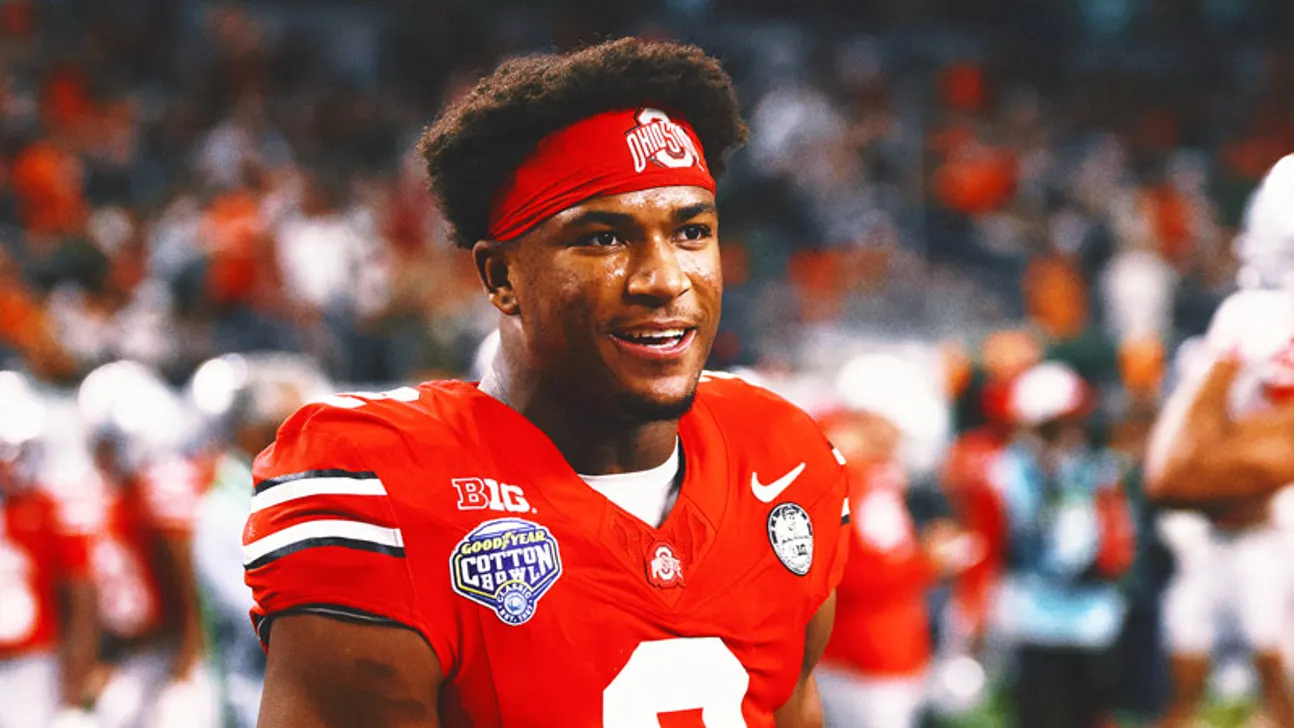
At Ohio State, Caleb Downs has quickly established himself as a defensive centerpiece, a player whose presence changes how opposing offenses approach game planning. Since arriving in Columbus, he has brought a level of polish and maturity uncommon for his age, paired with the kind of sideline-to-sideline explosiveness that allows him to erase mistakes and create turnovers in equal measure. His impact is not always fully captured by traditional statistics, but coaches and analysts consistently point to his ability to diagnose plays before they fully develop, his rapid trigger in run support, and his exceptional spatial awareness in pass coverage. These traits are what prompted Klatt’s comparison, not as a casual compliment, but as an analytical projection of how Downs’ skill set translates to the highest levels of football.
The reference to Ed Reed carries significant weight. Reed, a Hall of Fame safety who defined an era with the Baltimore Ravens, is widely regarded as one of the greatest defensive playmakers in NFL history. Known for his uncanny ability to read quarterbacks, anticipate routes, and turn defensive possessions into game-changing turnovers, Reed set a standard for the safety position that remains difficult to match. His film study habits were legendary, his anticipation almost supernatural, and his knack for being in the right place at the right time reshaped how teams valued the position. For Klatt to place Downs in that conversational orbit is to suggest not only similarity in playing style but also in football processing speed and instinctive understanding of offensive structure.
What makes Downs particularly fascinating within Ohio State’s system is how seamlessly he has adapted to multiple roles in the secondary. He is not confined to a single alignment or responsibility. Instead, he is deployed as a hybrid defender, capable of functioning deep in coverage, stepping into the box as a run defender, or rotating into underneath zones where quarterbacks least expect a disruptive presence. That versatility mirrors modern defensive evolution, but Downs executes it with a level of precision that suggests long-term mastery rather than developmental potential. His transitions between assignments are fluid, and his recognition skills allow him to minimize hesitation, a trait that separates good defenders from elite ones.
Klatt’s comparison also reflects the growing appreciation for how rare true “field generals” in the secondary have become. In an era dominated by spread offenses, tempo, and increasingly complex passing schemes, safeties are often required to make split-second decisions with limited margin for error. Downs thrives in this environment. He processes information quickly, communicates effectively with teammates, and adjusts alignments pre-snap with a confidence that belies his experience level. These are the same qualities that defined Reed’s dominance during his prime, where his understanding of offensive tendencies allowed him to dictate outcomes rather than simply react to them.
At Ohio State, the coaching staff has leaned heavily into Downs’ leadership qualities as well. Despite being relatively early in his collegiate career, he has already become a voice in the secondary, helping organize coverage schemes and reinforcing discipline in execution. That leadership presence is particularly valuable within a program that consistently competes at the highest level of college football, where small mistakes often determine the outcome of championship-contending games. His teammates frequently rely on his communication to adjust to motion, shifts, and pre-snap disguises, further highlighting his central role in the defensive structure.
Beyond his mental acuity, Downs possesses the physical traits that make his style sustainable at the next level. His closing speed allows him to erase space quickly, whether breaking on short throws or pursuing ball carriers in the open field. He plays with controlled aggression, rarely overcommitting and maintaining balance even in chaotic situations. His tackling technique is consistently sound, minimizing missed opportunities and ensuring that when he arrives at the football, the play is effectively over. These physical tools, combined with his processing ability, create a profile that NFL scouts have increasingly begun to prioritize in modern defensive schemes.
The Ed Reed comparison becomes even more compelling when examining Downs’ ability to generate turnovers. While interceptions are often viewed as opportunistic, players like Reed—and potentially Downs—treat them as a byproduct of preparation and anticipation. Downs has shown an ability to read quarterback intentions, identify route combinations, and break on the football with decisiveness. His positioning rarely appears accidental; instead, it reflects calculated understanding of down-and-distance tendencies and offensive preferences. This is where Klatt’s analogy finds its strongest footing, as Reed built his legacy on turning film study into game-altering plays.
Within the broader context of Ohio State football, Downs represents a continuation of the program’s tradition of producing elite defensive backs, yet he also stands out even within that lineage. The Buckeyes have long been known for sending defensive talent to the NFL, particularly in the secondary, but Downs brings a different dimension. His ability to function as both a stabilizing force and a dynamic playmaker gives Ohio State flexibility in defensive design, allowing coordinators to disguise coverages more effectively and apply pressure without sacrificing structural integrity on the back end.
Opposing offensive coordinators have already begun adjusting their approach when preparing for Ohio State, often accounting specifically for Downs’ presence. That level of respect is typically reserved for veteran professionals rather than college underclassmen, and it speaks to how quickly he has influenced game planning. Quarterbacks are forced to hold the ball longer, hesitate on intermediate throws, and reconsider deep safety windows, all of which ripple through the offensive structure. In many ways, Downs functions as a deterrent as much as a playmaker, altering behavior simply by occupying the field.
Looking ahead to his NFL projection, the Reed comparison inevitably raises expectations, but it also frames a realistic pathway for his development. At the professional level, versatility and intelligence at the safety position are increasingly valuable as defenses adapt to modern offensive complexity. Players who can disguise intentions, rotate coverage responsibilities, and still maintain elite execution in open-field scenarios are rare and highly coveted. Downs fits that mold, and while comparisons to all-time greats should always be made cautiously, his trajectory aligns with the type of impact player NFL franchises build defensive identities around.
Scouts evaluating Downs will likely focus on how his instincts translate against faster, more sophisticated offenses at the next level, but early indicators suggest his processing ability is not dependent on collegiate limitations. His anticipation skills, combined with disciplined technique, suggest a strong foundation that should scale upward. Additionally, his competitive temperament and willingness to engage physically in run support demonstrate a complete defensive profile rather than a one-dimensional coverage specialist.
Klatt’s remarks ultimately serve as a reminder of how rare it is to encounter defensive players who consistently influence games from the safety position. In modern football, attention often gravitates toward quarterbacks, edge rushers, and offensive skill players, but the value of a transcendent safety remains undeniable. Ed Reed’s legacy is a testament to how one player in the secondary can redefine defensive strategy, and while it is far too early to place Caleb Downs in that historical category, the stylistic parallels are difficult to ignore.
As Ohio State continues its pursuit of national championship contention, Downs will remain central to its defensive ambitions. His presence not only elevates the performance of those around him but also provides the Buckeyes with a foundational piece capable of shifting momentum in high-stakes moments. Whether breaking up a critical third-down pass, forcing a turnover in open space, or orchestrating coverage adjustments pre-snap, he consistently finds ways to impact the game beyond conventional expectations.
In the end, Joel Klatt’s comparison is less about declaring Caleb Downs the next Ed Reed and more about recognizing the rare convergence of traits that define generational defensive backs. Instinct, intelligence, versatility, and playmaking ability do not often align in one player, especially at such an early stage of development. Yet in Downs, Ohio State appears to have found a defensive anchor whose influence is already being felt across the college football landscape, and whose future continues to invite comparisons to the very best who have ever played the game.