Ryan Day has spent much of his Ohio State tenure operating under the brightest lights in college football, where five-star recruiting victories, College Football Playoff expectations and national championship pressure routinely dominate the conversation.
But one reported gesture involving a walk-on reveals a different side of the Buckeyes’ head coach — one that has little to do with recruiting rankings or Saturday afternoon results.
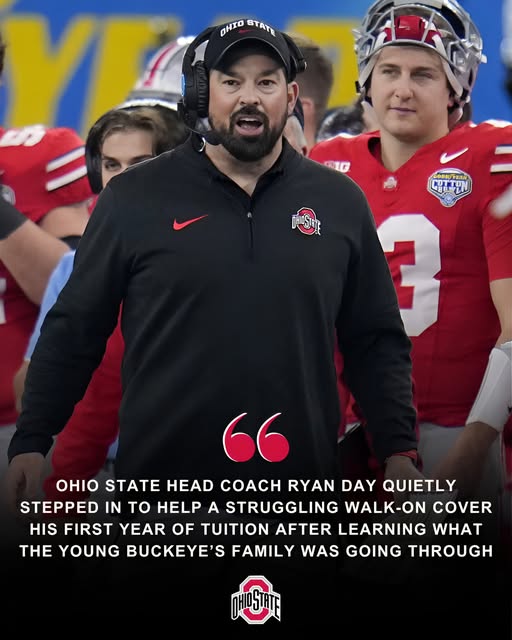
According to report circulating about the Ohio State program, Day learned that one of his walk-on players was facing significant financial difficulty as his family struggled to cover the cost of his first year at Ohio State. Rather than allow the young player to quietly carry that burden, Day reportedly stepped in and helped cover his tuition.
The financial assistance was meaningful. What allegedly followed was even more so.
Day’s message to the player reportedly went beyond the immediate problem of paying a university bill. The coach made clear that the player’s value to the program was not determined by his scholarship status, his recruiting ranking or how often his name appeared on the stat sheet.
That distinction matters at a program such as Ohio State, where the distance between a highly recruited scholarship player and a walk-on can be enormous on paper but considerably smaller inside a locker room.
The specific report has not been publicly substantiated by Ohio State or Day, and the player’s identity has not been independently confirmed. But the broader circumstances surrounding walk-ons, college costs and Day’s approach to player development provide important context for why such a gesture would resonate so strongly within the Buckeye program.
At Ohio State, being a walk-on can mean assuming a significant financial responsibility before a player ever has the opportunity to contribute on the field.
The university’s published 2026-27 figures put tuition and fees for an Ohio resident attending the Columbus campus at $14,050 for the academic year. Housing and food add another $15,738, while Ohio State estimates additional expenses for books, transportation and personal costs. For an in-state freshman living on campus, the university’s estimated total cost of attendance is more than $34,000.
For a family already under financial strain, that is not a marginal expense. It can determine whether a player gets the opportunity to pursue his education and football ambitions at all.
And that is where the walk-on story intersects with the larger transformation of college football.
The sport has entered an era in which roster construction increasingly resembles professional team building. NIL opportunities, revenue sharing, transfer-portal movement and scholarship management have become central components of roster strategy. Ohio State has embraced that reality aggressively, building one of the country’s most talent-rich programs while attempting to balance financial resources with competitive expectations.
Yet the fundamental promise of college athletics remains more personal for the players living inside those systems.
Walk-ons still practice against scholarship players. They still travel, lift weights, attend meetings and sacrifice weekends. They can become scout-team stars, special-teams contributors and, occasionally, unexpected starters.
Ohio State’s history includes numerous walk-ons who earned scholarships after proving themselves within the program. Former offensive lineman Kevin Woidke, for example, arrived as a walk-on and eventually earned a scholarship under Day. Woidke had told Day that earning a scholarship was one of his goals, while also making clear that he intended to remain committed to the team even if that opportunity never came.
That is the culture in which Day has operated.
Since taking over as Ohio State’s head coach, Day has built one of the most successful programs in the country. He inherited an elite standard from Urban Meyer and maintained it, while also navigating the increasingly complicated economics of modern college football.
The results have been extraordinary.
Ohio State entered the 2024 season carrying the pressure that accompanies every Buckeye season: win the Big Ten, beat Michigan and compete for a national championship. The Buckeyes ultimately lost to Michigan during the regular season, 13-10, but responded with four consecutive College Football Playoff victories over Tennessee, Oregon, Texas and Notre Dame to win the national championship.
That championship changed the conversation around Day.
Before the postseason run, questions about his record against Michigan and his ability to finish at the highest level had become unavoidable. After Ohio State’s championship, the program rewarded him with a new seven-year contract that runs through the 2031 season and is worth $12.5 million annually.
The contract places Day among the highest-paid coaches in college football and reflects the expectations attached to his position.
But there is no salary-cap accounting for moments like the one described in the walk-on story.
College football does not operate under an NFL-style salary cap. Instead, schools are dealing with scholarship limits, NIL structures and the emerging framework for direct athlete revenue distribution. That makes every dollar associated with roster construction increasingly consequential.
Ohio State’s challenge is not simply acquiring elite talent. It is creating a sustainable ecosystem capable of keeping that talent developed, academically eligible and connected to the program.
That last element can be overlooked.
A walk-on who knows his head coach cares about his circumstances may approach the program differently. A player who feels valued beyond his scholarship status can become more invested in the collective. And when the coaching staff establishes that culture, it can have consequences far beyond one player’s financial situation.
There is also an important leadership component.
The most effective coaches understand that players rarely remember every speech delivered in a team meeting. They remember individual moments.
They remember the assistant who stayed late after practice.
They remember the coach who called home.
They remember who noticed when something was wrong.
For a young player entering a massive university while his family is struggling financially, knowing that his head coach recognized the problem and responded could carry significance long after the tuition bill disappeared.
That does not make Day’s reported gesture a substitute for Ohio State’s institutional financial-aid system. It also does not change the competitive realities of a program that routinely recruits players from across the country and expects them to compete for championships.
But it does offer a glimpse into the human side of a job that is increasingly defined by transactions.
The irony is that Day’s biggest professional achievements have come amid precisely the opposite kind of environment.
His program is now deeply involved in the modern economics of roster management. Ohio State’s leadership has openly acknowledged the need to adapt to revenue-sharing structures, roster evaluation and what athletic director Ross Bjork has described as the changing model for building a roster. Day himself has been tasked with learning how the emerging financial system will affect roster construction.
The Buckeyes cannot afford to ignore those realities.
Neither can any serious contender in the Big Ten.
Oregon, Penn State, Michigan, USC and other national programs are operating in the same increasingly competitive environment. The teams that adapt most effectively will have advantages in recruiting, retention and roster depth.
But football programs remain collections of people.
And for all the millions involved in modern college football, the difference between a player staying committed and a player walking away can sometimes come down to something much smaller than a contract or NIL valuation.
It can be a conversation.
It can be a coach recognizing a problem before the player asks for help.
It can be a reminder that the person wearing the helmet matters before the player ever steps onto the field.
That is why the reported story involving Day and the Ohio State walk-on has attracted attention.
The money itself is relatively small when compared with the financial scale of a program that employs a head coach making $12.5 million per year. Ohio State’s published tuition figures make the assistance significant to the individual player, but the amount is microscopic within the economics of major college football.
The symbolism is much larger.
For Day, whose career is now measured in championships, playoff victories, recruiting classes and contract figures, the reported interaction represents a different form of leadership.
For the player, it may have represented the moment when Ohio State stopped being simply a football destination and became a place where someone was willing to invest in him as a person.
And for a program increasingly defined by the business of winning, that may be the most valuable lesson of all.
The Buckeyes will continue to recruit elite prospects. They will continue to navigate the transfer portal. They will continue to compete for Big Ten titles and College Football Playoff berths.
But championships are built from more than five-star recruits.
They are built from the players who practice when nobody is watching, the walk-ons who push scholarship athletes every afternoon, the special-teams contributors whose names rarely appear in headlines and the coaches who understand that every roster spot belongs to a human being.
If the account of Day helping that player through his first year is accurate, the gesture was never really about tuition.
It was about making sure one young Buckeye understood that he belonged.
And sometimes, in a sport increasingly obsessed with what a player is worth, reminding someone that he has value can mean far more than the number written on a bill.