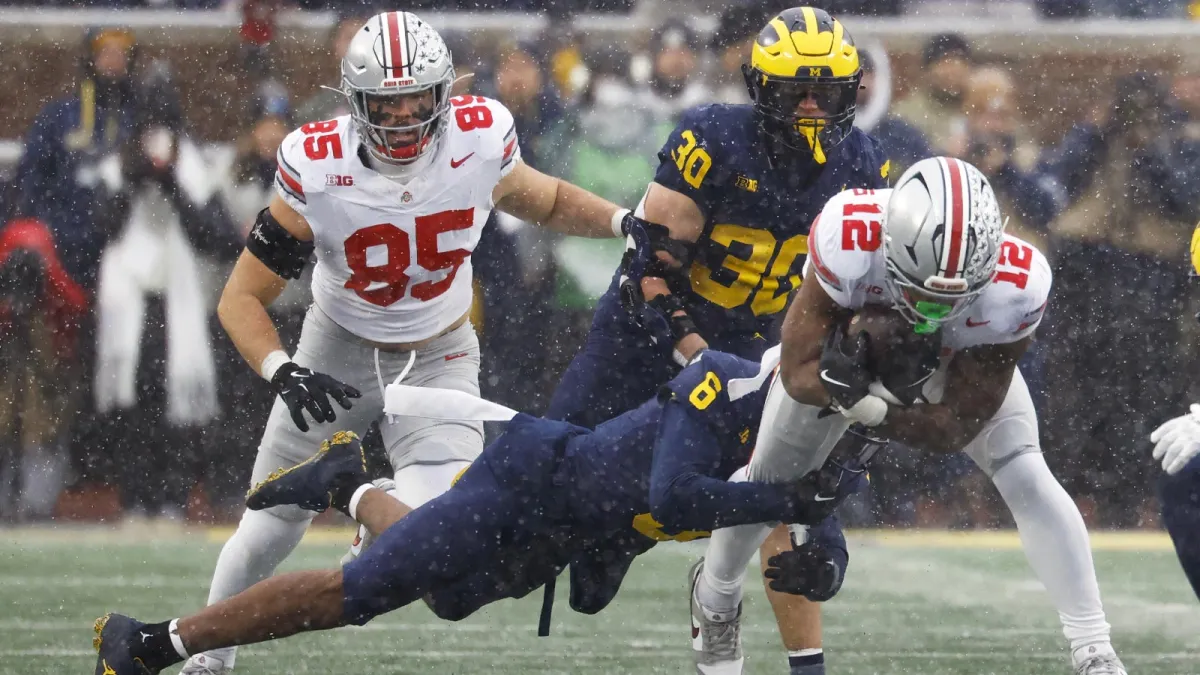
Ohio State head coach Ryan Day didn’t hesitate, didn’t soften his tone, and certainly didn’t attempt to downplay what many around the program—and across college football—already understand. When it comes to the rivalry with Michigan, there is no gray area. There is no diplomatic middle ground. For Day, the significance of that annual clash is as large as it has ever been, and perhaps even larger in an era where the sport continues to evolve at a rapid pace.
Speaking with a level of conviction that mirrored the intensity of the rivalry itself, Day made it clear that the stakes tied to facing Michigan extend far beyond rankings, postseason implications, or even conference titles. It is, in his words and demeanor, something that defines the program, shapes its identity, and resonates deeply with players, alumni, and fans alike. In a time when college football is being reshaped by transfer portals, NIL deals, and expanded playoffs, the emotional core of the sport—rivalries like this one—remains untouched.
For Ohio State, the Michigan game has always been circled on the calendar. It is not just another matchup. It is the game. That sentiment has been passed down through generations of players and coaches, and Day has embraced that responsibility fully since taking over the program. His message reflects an understanding that success at Ohio State is measured differently. Wins over other opponents matter, championships matter, but beating Michigan carries a weight that cannot be replicated.
Day’s remarks come at a time when scrutiny around the rivalry has intensified. Recent results have not gone Ohio State’s way, and in a program accustomed to dominance, that shift has been impossible to ignore. Rather than deflect or minimize the narrative, Day confronted it head-on. His acknowledgment of the rivalry’s outsized importance was not an attempt to appease critics, but rather a reflection of internal standards that have long existed within the program.
There is a psychological element to rivalries that goes beyond strategy and execution. Players are not just preparing for another opponent; they are stepping into a game that carries historical significance and emotional intensity. Day emphasized that understanding this distinction is crucial. Preparation for Michigan is not just about game plans and film sessions. It involves instilling a mindset that recognizes the magnitude of the moment.
The Ohio State-Michigan rivalry, often referred to simply as “The Game,” has a history that stretches back more than a century. It has decided conference championships, influenced national title races, and produced countless iconic moments. For players, participating in this rivalry is an opportunity to become part of something much larger than themselves. Day’s comments suggest that he is keenly aware of that legacy and the responsibility that comes with it.
In modern college football, where player movement is more fluid than ever, maintaining a sense of tradition can be challenging. Rosters turn over quickly, and not every player arrives with a deep understanding of a program’s history. Day acknowledged this reality but stressed the importance of education and immersion. From the moment players step onto campus, they are introduced to what the Michigan rivalry means. They are taught its history, its significance, and the expectations that come with wearing the Ohio State uniform in that particular game.
Day’s approach reflects a broader philosophy about culture within the program. He believes that sustaining success requires more than talent. It requires alignment—coaches, players, and staff all operating with a shared understanding of priorities. And within that framework, the Michigan game stands at the forefront. It is a benchmark against which seasons are judged and legacies are defined.
Critics might argue that placing such heavy emphasis on a single game can be risky. College football seasons are long and demanding, with multiple high-stakes matchups along the way. Yet for Day, acknowledging the rivalry’s importance does not diminish the significance of other games. Instead, it reinforces a standard of excellence that applies across the board. If a team is prepared to meet the emotional and physical demands of the Michigan game, it is likely prepared for anything else on the schedule.
There is also a leadership component to Day’s stance. As the head coach, his words set the tone for the program. By speaking candidly about the rivalry, he sends a message to his players that there is no room for complacency or indifference. The expectation is clear: this game matters, and it demands their best effort.
Day’s comments also resonate with the fan base, which views the Michigan rivalry as a cornerstone of Ohio State football. For supporters, victories in this game are a source of pride, while losses can linger long after the season ends. By aligning himself with that perspective, Day reinforces the connection between the program and its community. He understands that coaching at Ohio State is not just about wins and losses; it is about representing a tradition that holds deep meaning for millions of people.
In recent years, Michigan has reasserted itself as a formidable opponent, adding another layer of urgency to the rivalry. The balance of power has shifted, creating a heightened sense of anticipation each time the teams meet. For Ohio State, reclaiming dominance in this matchup has become a priority, and Day’s remarks reflect a determination to address that challenge directly.
Preparation for a rivalry game often involves unique elements. Coaches may adjust practice routines, incorporate motivational tools, or emphasize specific aspects of the opponent’s tendencies. Day hinted at the comprehensive nature of Ohio State’s approach, noting that every detail is scrutinized. From game planning to mental preparation, nothing is left to chance.
At the same time, Day recognizes that players must strike a balance between emotion and execution. The intensity of a rivalry game can be both a strength and a potential pitfall. Harnessing that energy effectively is key. Too much emotion can lead to mistakes, while too little can result in a lack of urgency. Day’s role includes guiding his players to find that equilibrium.
The broader college football landscape continues to evolve, with discussions about conference realignment, playoff expansion, and the commercialization of the sport dominating headlines. Amid these changes, rivalries like Ohio State-Michigan serve as a reminder of what makes college football unique. They are rooted in history, fueled by passion, and defined by moments that transcend the game itself.
Day’s refusal to downplay the rivalry can be seen as a commitment to preserving that essence. In an era where external factors often shape narratives, his focus remains on the core elements of the sport. The Michigan game is not just another data point in a season; it is a defining chapter.
For players, the opportunity to compete in such a game is both a privilege and a challenge. It requires mental toughness, physical resilience, and an ability to perform under pressure. Day’s emphasis on the rivalry underscores his belief that these experiences are integral to player development. Facing Michigan is not just about the outcome; it is about growth, character, and the ability to rise to the occasion.
As the season progresses and anticipation builds, Day’s comments will likely continue to be a focal point of discussion. They provide insight into his mindset and the priorities that guide his program. More importantly, they reflect a broader understanding of what it means to lead a team in one of college football’s most storied rivalries.
There is a certain clarity in Day’s approach. He does not attempt to redefine the rivalry or diminish its significance. Instead, he embraces it fully, acknowledging both its challenges and its rewards. That perspective resonates within a program that prides itself on tradition and excellence.
Ultimately, the Michigan game will be decided on the field, where preparation meets execution. But the foundation for that performance is built long before kickoff. It is shaped by the messages delivered in meeting rooms, the standards upheld in practice, and the mindset cultivated throughout the season. Day’s candid remarks are a reflection of that process.
In a sport where narratives can shift quickly, one constant remains: the importance of rivalries. For Ohio State, the annual clash with Michigan is more than just a game. It is a measure of success, a test of character, and a defining moment in every season. Ryan Day understands that reality, and he is not shying away from it.